If you haven’t already heard…
I’m hosting a 12-week Group Self-Paced Version of Foundations – starting this week on Wednesday, 18 June 2026.
This will be a chance to sketch your way through Foundations alongside an inspiring cohort of sketchers worldwide!
Each week, you’ll be prompted to move on to the next section of the course, and there will be a bonus livestream with me at the start of the course to introduce the concepts and so that you can ask questions in real time. I love sharing the concepts for this course!
Click here for the lesson schedule and the livestream date and time.
I only do a group version for Foundations once a year, so this is a big event!
Foundations, my most popular course, covers all the essential skills every sketcher should have. Designed for beginners, it teaches fundamental observational skills and urban sketching basics.
It’s also perfect for self-taught sketchers seeking improvement or seasoned sketchers wanting to work faster.
In Foundations, you’ll learn to:
- Build a solid foundation with essential skills for sketching
- Develop effective techniques for sketching on location, regardless of subject matter
- Improve your ability to sketch faster and more spontaneously
Foundations sets the stage for all my other courses, containing the essential techniques I use in every sketch. I love revisiting the basics, and each time I go through Foundations, I develop new techniques!
Find out more about Foundations
12-week Group Self-Paced Version
starting 17 June 2026
Work through the course with
an inspiring group of sketchers from around the world and
take part in an interactive Live Q&A session for
real-time insights and inspiration
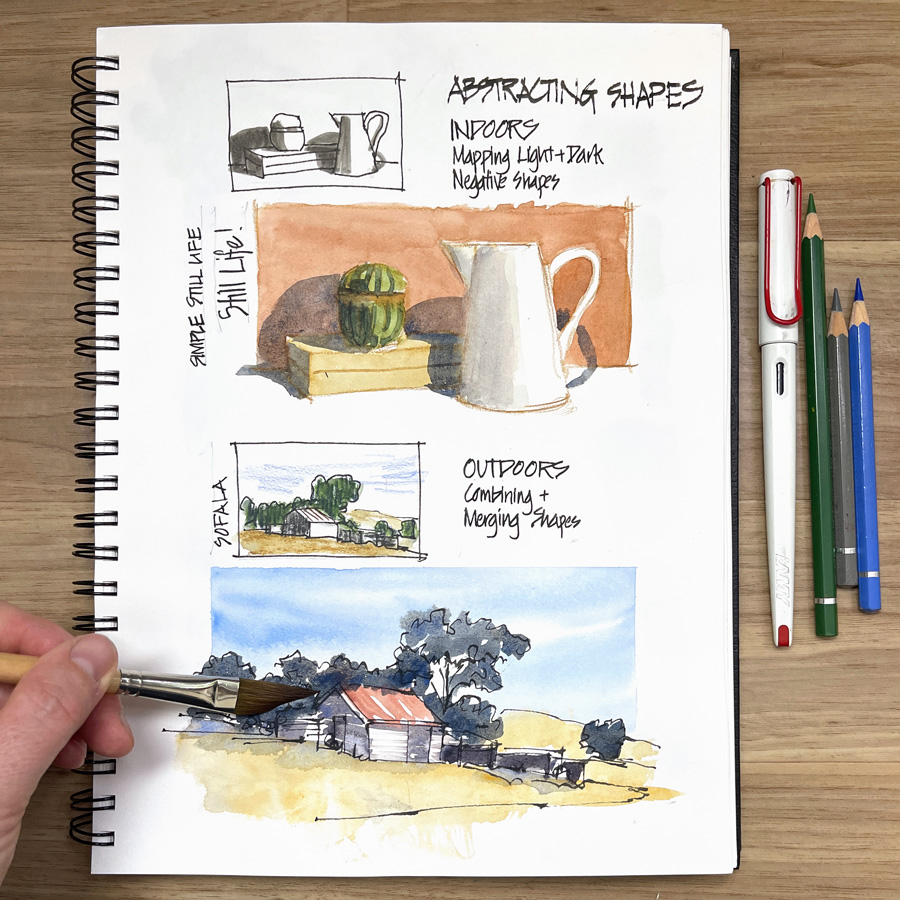
In preparation for this Foundations Group Event, I’ve put together a collection of images that illustrate the course’s main themes using more recent Foundations demos!
Are any of these concepts things that you want to develop in your own work?
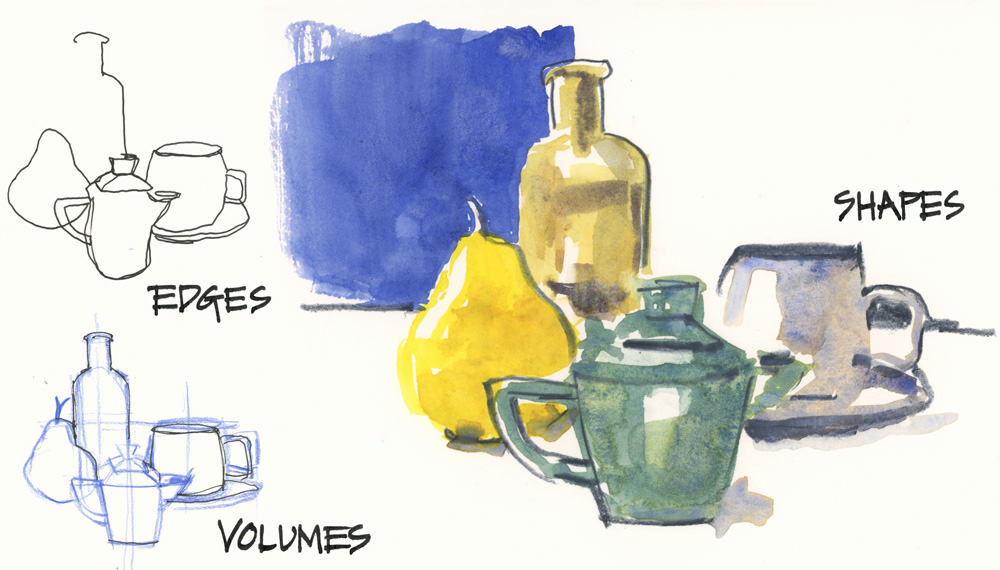
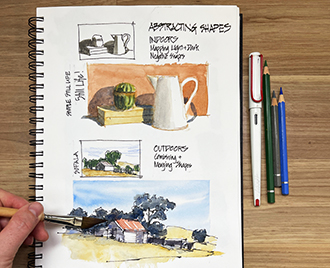
The core skill we develop inside Foundations is learning to see the world in terms of edges, shapes and volumes (ESV).
I have a specific way of thinking about these: Feeling Edges, Abstracting Shapes and Constructing Volumes.
I think about edges, shapes, or volumes (or all three) in every sketch I do, and whenever a sketch (or a part of a sketch) isn’t quite working, I go back to thinking about ESV.
In Foundations, we use edges, shapes, and volumes for simple objects (such as this still life) and more complex scenes (see below).

Here are a few more ESV examples from the course. 🙂
(Yes, there is a Borromini demo in Foundations!)

Learning to simplify objects and scenes into big shapes is an essential skill for painting.
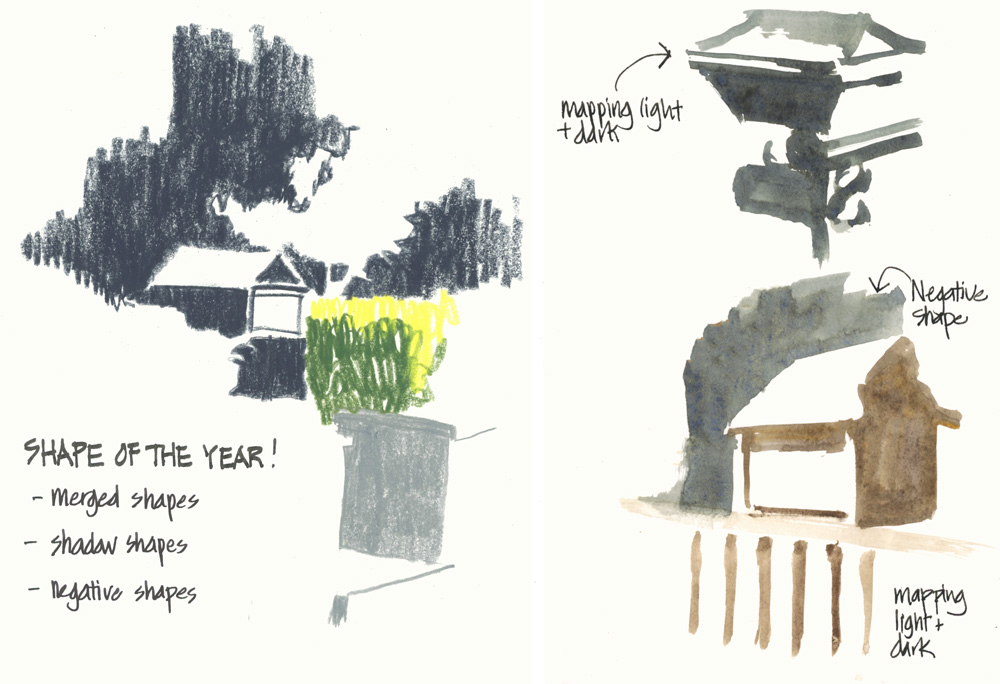
But you can use shapes for any media.
Note: I got a bit excited doing the demo on the left, calling it ‘the shape of the year’ because it featured a beautiful mix of shadow and negative shapes.
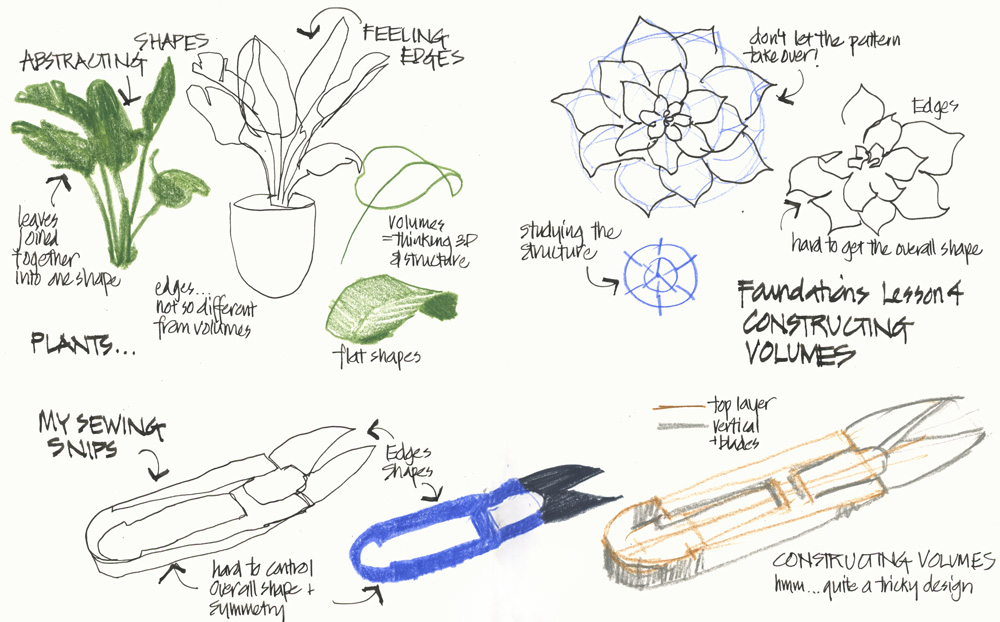
When to use volumes. BTW I particularly enjoyed doing a demo of my sewing snips!
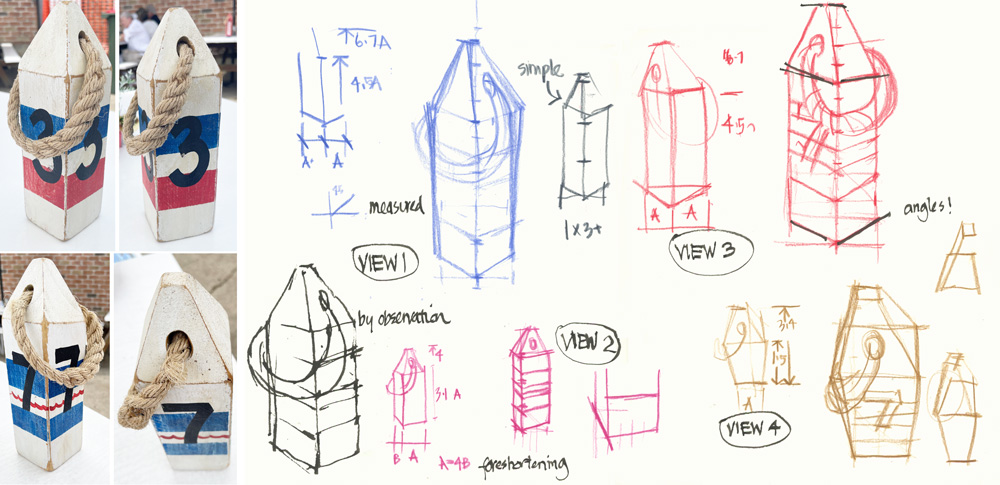
We also look at accuracy – how to sight measure or use what I call ‘minimal setup’.
Here are my working drawings for four different views of a Cafe Table Number. I never cease to be amazed when measuring foreshortened lengths – compare View 1 with View 4!
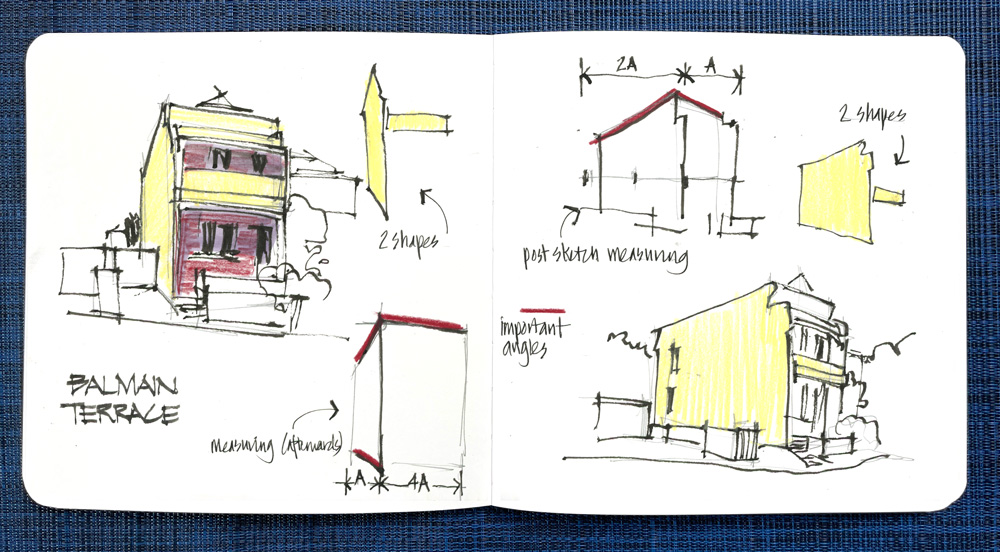
Many beginner sketchers are obsessed with learning perspective, and while it is good to understand perspective eventually, developing basic observational skills is more important. This image shows you how I drew these two sketches of a terrace house, thinking about shapes, angles, and foreshortened lengths – I didn’t use perspective!
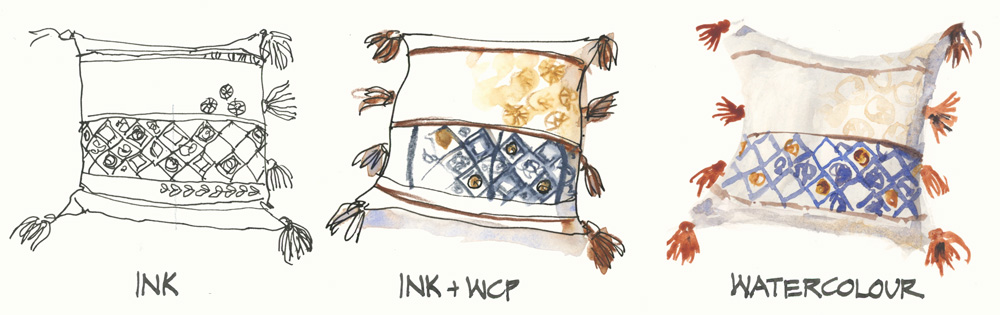
We also look at how to combine ink and watercolour and how to decide what to draw in ink and what to describe in watercolour. Or maybe even use watercolour pencils, especially for a detailed object.
There are many different ways to approach ink and wash – this image shows three demos of a patterned cushion.
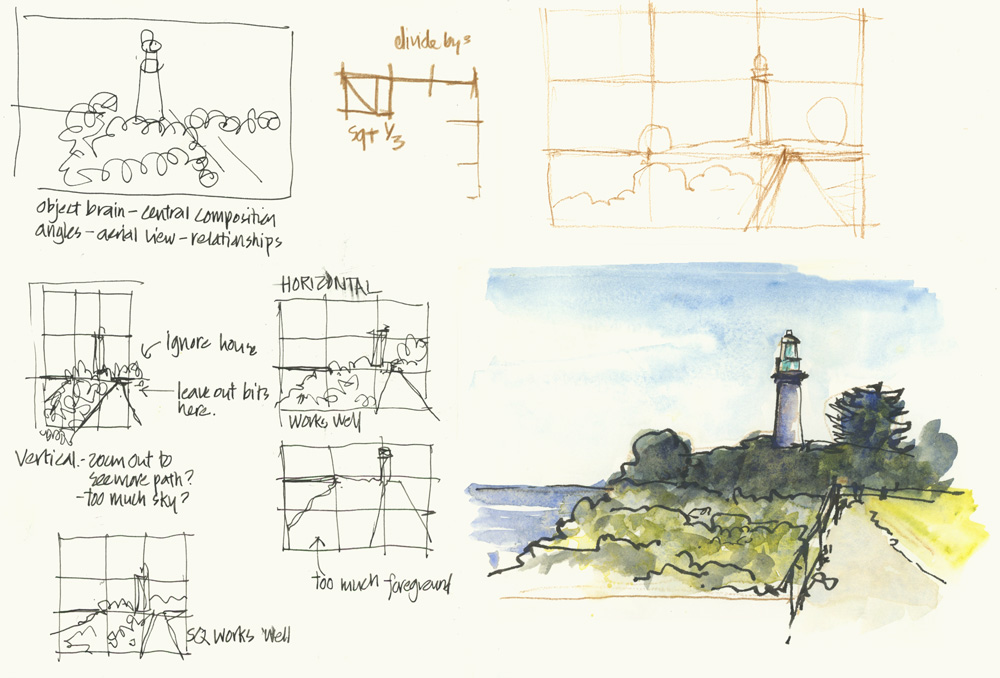
In the last part of the course, we focus on basic skills for sketching on location. We’ll explore strategies for limiting what we sketch (ie. we don’t have to draw everything!) and we’ll learn how to draw the main edges going in the right direction! 🙂
Note: Although the ultimate goal is to sketch on location, it’s totally okay to do the exercises from photos.
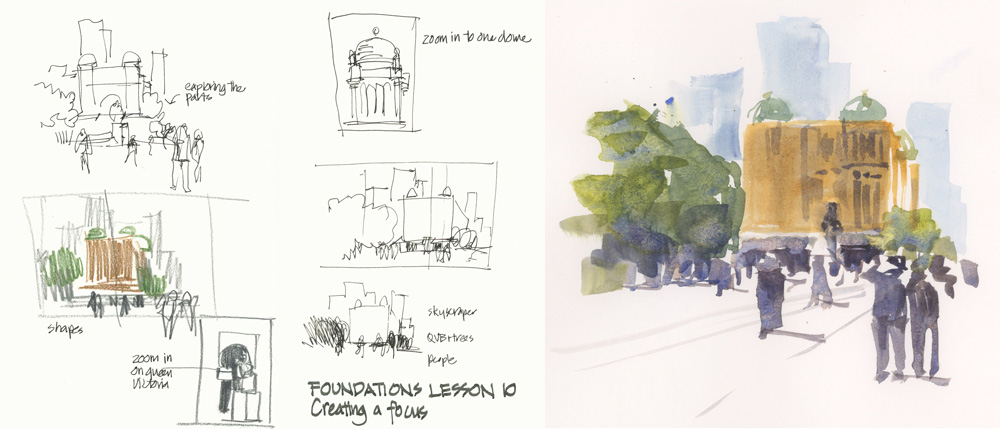
We also explore simple composition rules and how to create a focus for our sketch. Once again, using shapes and important edges to help with this!
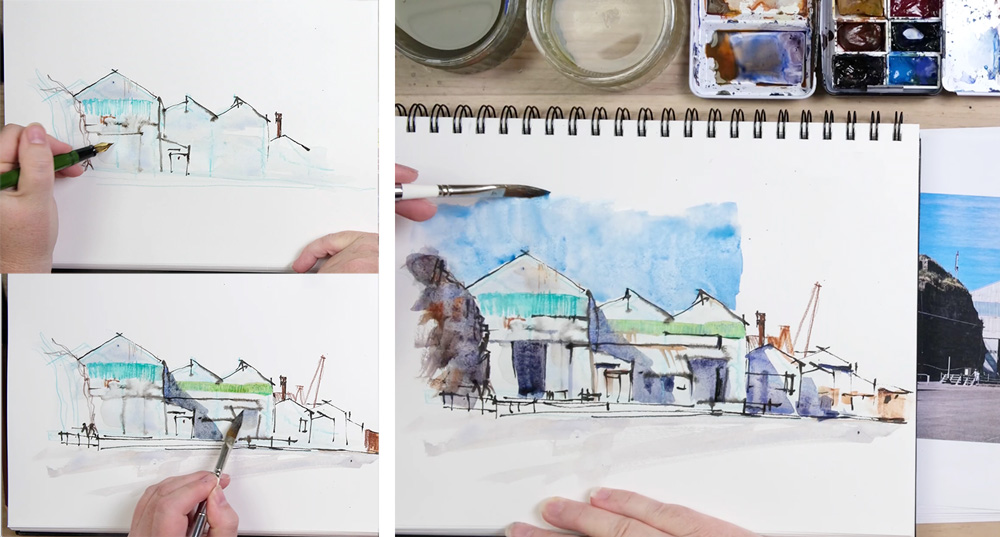
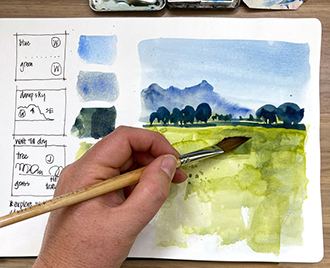
The last concept that I’ll share today is the idea of working out from a focus. This involves starting a sketch with the most important part of the scene (the focus) and then working spontaneously out from that point. Here are a few process photos from a demo I did last year when we went through the course.
Ah! Putting this article together is definitely increasing my excitement to revisit Foundations again! 🙂 I love this course so much!
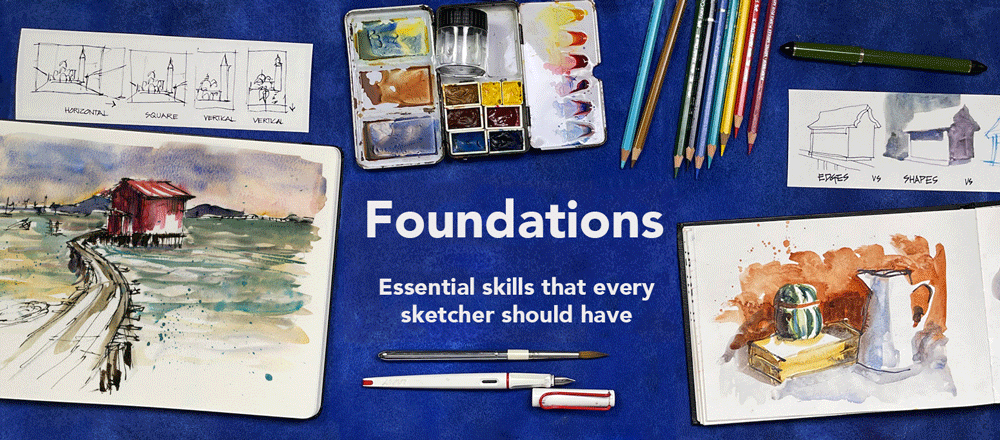
As you can see from this summary of concepts, Foundations is a comprehensive course designed to be an ongoing resource!
You have lifetime access to all the lessons (and livestream replays) and free access to all future group events. Many Foundations participants have gone through the course numerous times.
If you have purchased Foundations at any time you can be part of this Group Version for free! To join – simply go to the Foundations classroom via My Account/My Courses on the SketchingNow site and follow the instructions under the Welcome video. Or check out the email I sent to you last week!
I would love you to be part of this cohort!
Finally…
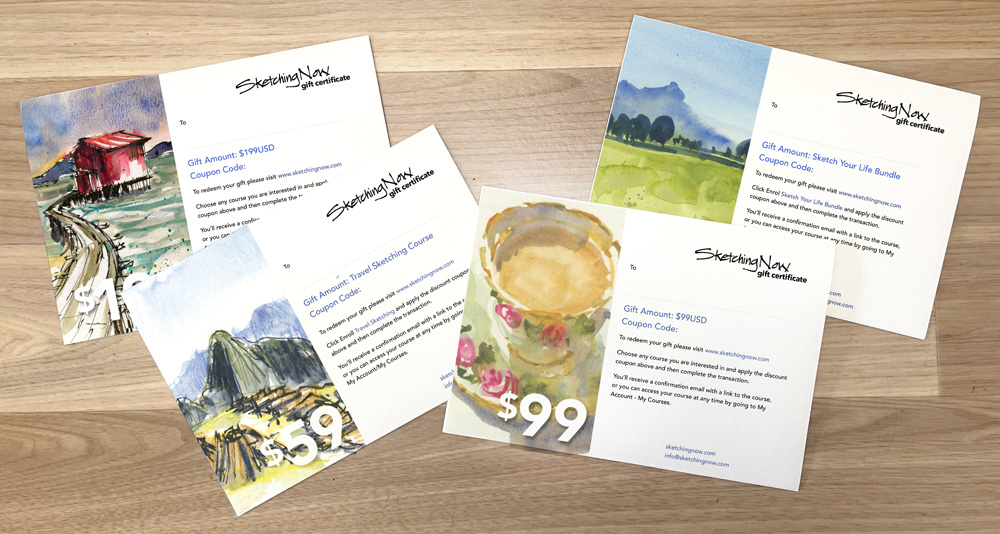
1. Gift Certificates I have Gift Certificates available for my SketchingNow courses and bundles – starting at only $59 USD. Each one comes with a printable gift certificate. Find out more here.
2. Free Intro Lessons If you want to find out more about Foundations, I have three free Intro Lessons – sign up for them here.
If it’s a good fit for you, I would love you to be part of this Group Version of Foundations.


NEWSLETTER
Subscribe for first notification of workshop + online classes and more.