If you want to become an urban sketcher…
The best way to begin is to simply get outside and start sketching!
Don’t worry about materials, how good your sketches are or what other people think.
Don’t think that you have to become ‘good enough’ before you go out sketching on location.
Just get outside and try it!
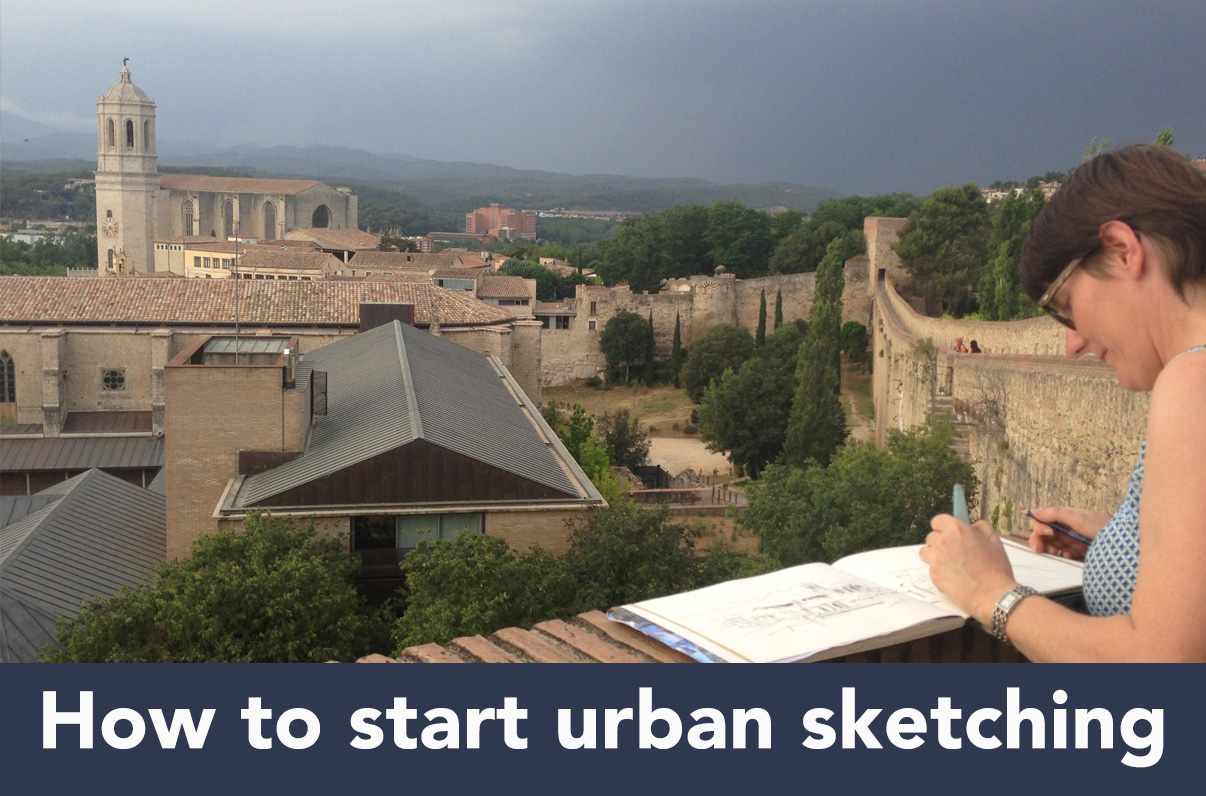
Hi, I’m Liz Steel from Sydney, Australia, and I love to sketch!
I’ve been sketching in some form since I was a teenager, but started seriously in 2006, and my first watercolour sketch was done on location at the top of Mt Kosciuszko – the highest point in Australia. How’s that for starting on a high? 🙂
This is just before the global community of Urban Sketchers began and I feel very privileged that I’ve been part of it since the very beginning.
Urban sketching has many definitions, and in this article, I will mostly use the term ‘sketching on location’ so that it’s clear I’m referring to sketching away from home – whether that’s in a park, in a public place, in a cafe or from your car.
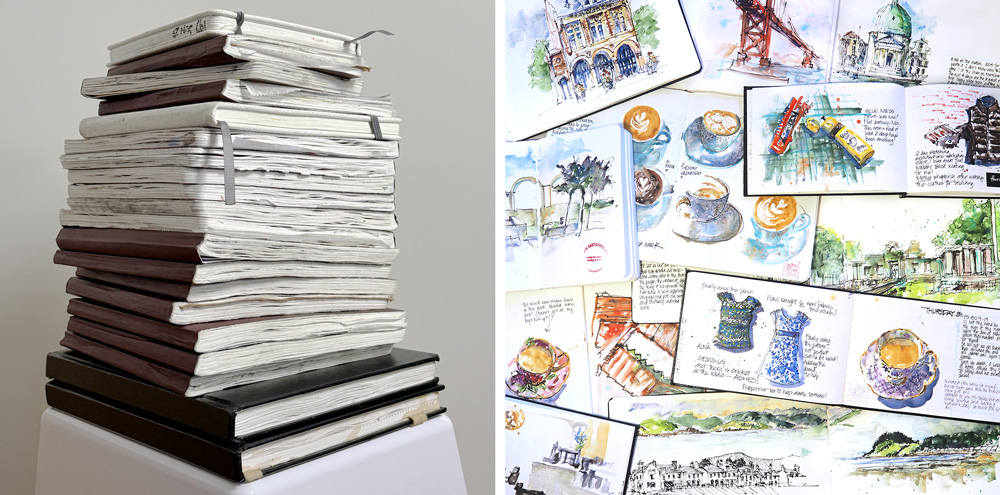
I’ve filled many sketchbooks over the years. I have a wall of sketchbooks in my studio and the above left photo shows all the books I completed in a single year! 🙂
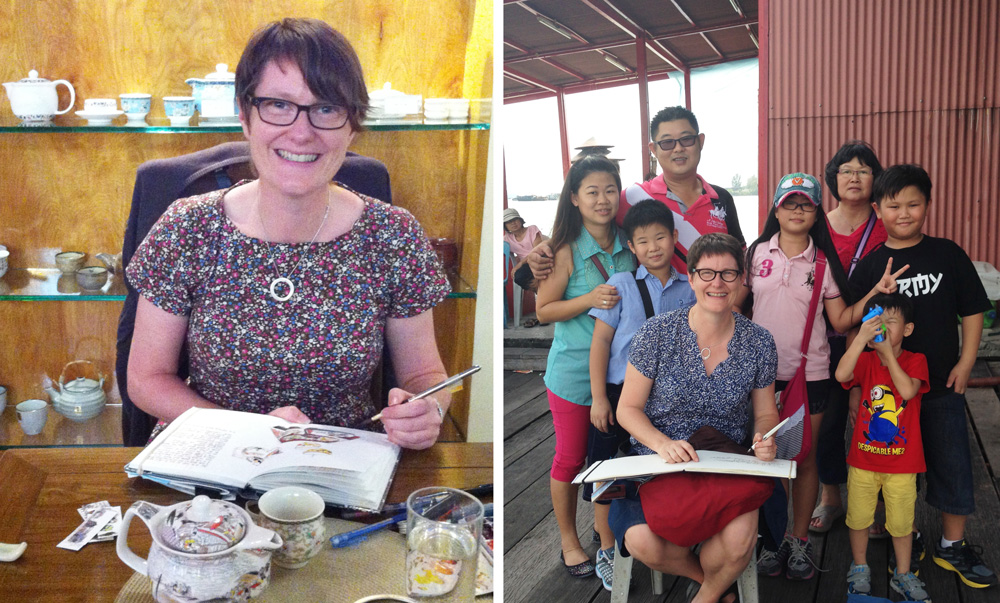
These sketchbooks contain sketches of a variety of subjects: objects at home (such as teacups), sketches done from photos (or from my imagination) and sketches done on location (as seen on the right).
I love all forms of art, but there is a magic about sketching on location.
It’s my happy place!
There is a special buzz I get when I’m sketching in public, which translates into a noticeable liveliness on my page. I love feeling the pulse of my environment and having brief interactions with the people around me.
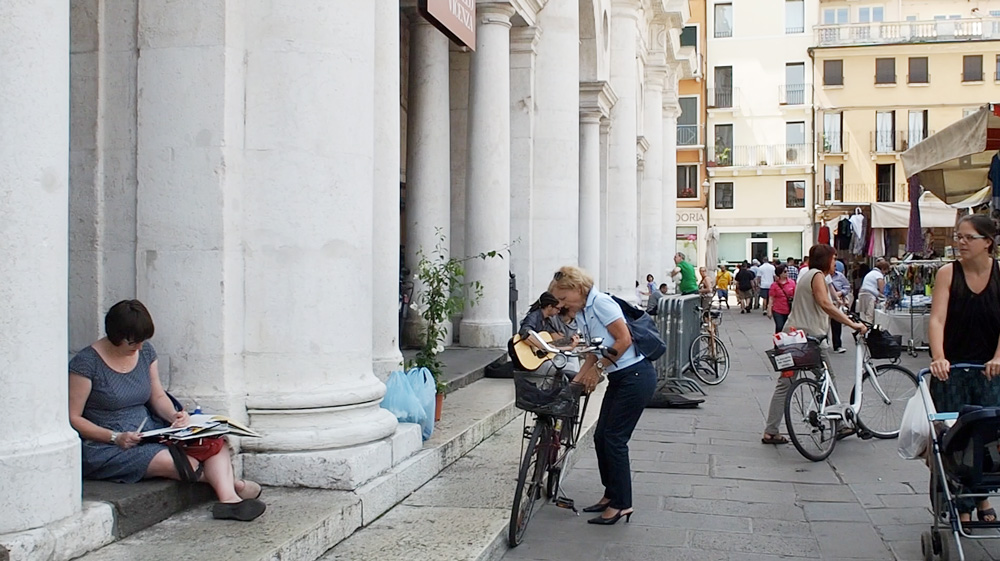
My top tips to start sketching on location
In this article, I’ll share my top tips for getting started sketching on location, and I hope it inspires you to get out there and sketch!
A. Three important mindsets to adopt before starting
B. Frequently Asked Questions
- FAQ1: How do I start sketching on location?
- FAQ2: What materials should I use?
- FAQ3: What should I sketch?
- FAQ4: How can I become more comfortable sketching on location?
- FAQ5: How do I get better at sketching?
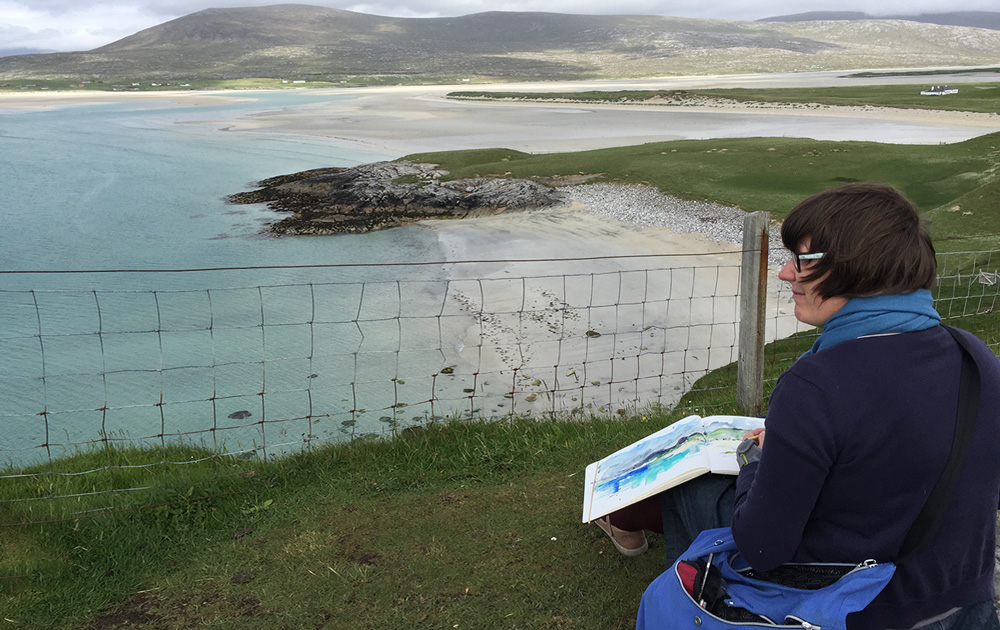
A. Essential mindsets for sketching on location
It can seem a little overwhelming to start sketching on location.
It’s easy to get bogged down by thinking you need to buy lots of new art supplies, have the perfect sketching kit, or to already know how to sketch before you go on location.
But creating art is as much a mental activity as it is doing something with your hand. And fear of sketching in public can become a huge barrier to beginning.
And so before going out on location, it’s important to start thinking in a way which will make it easier.
Mindset 1. Focus on the experience, not the result
Learn to see the world in a new way and start a conversation with yourself about what you are looking at in terms of edges, shapes and volumes – for example, ‘how long is this edge, what angle is it going at?’
If you focus on this dialogue, you’ll become less worried about how good your sketch is or people walking past.
Get excited about this act of discovery!
Mindset 2: Focus on enjoyment, not perfection
Your internal voice can become an inner critic, making unfair assessments of your drawings.
In the long-term, the best strategy to deal with your inner critic is to make friends with it (see more about this here), but when you are just starting, I recommend that you tell your inner critic: ‘I’m a beginner, and at this stage I want to have fun. I’m not trying to create perfect results.’
Hopefully, this will be enough to quieten your inner critic and help you push through.
Mindset 3. Focus on the journey, not the individual sketch
Don’t put pressure on yourself to do a ‘good’ sketch and don’t be discouraged by your first drawings. Instead, remind yourself that you are on a creative journey, and each sketch is a stepping stone to the next stage. Focus on that.
If you add a date and location to your sketch, it becomes part of something bigger. You’ll be creating a visual narrative of your life!
I have more to say about this topic, so if you need more pep talk, check out the expanded version here.
I can’t stress enough how important it is to have a positive mindset when you start sketching on location.
There will be many moments when you feel unhappy with what’s on your page, so you need to be able to push through and focus on the more fun aspects. And amazingly, you’ll discover that the sketches that are most frustrating at the time often become your favourites!
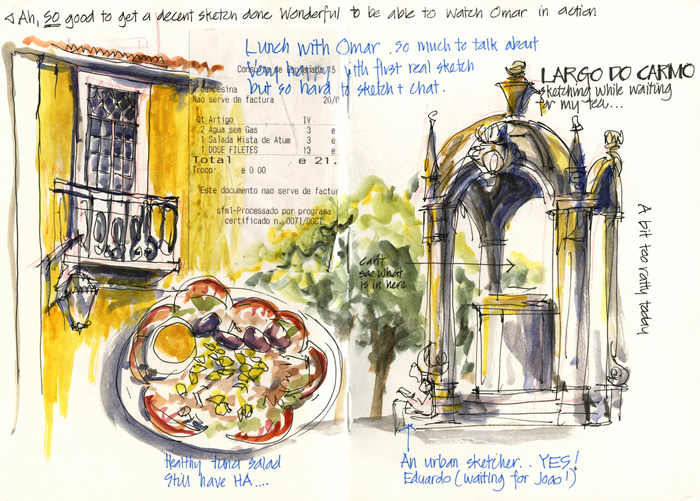
For example: There are lots of emotions recorded in this sketchbook page, which is one of my all-time favourites – including ‘so hard’, ‘a bit too ratty today’ and the fact that I had a HA = headache. But it also contains some very positive experiences: ‘so good’, ‘so much, ‘very happy’ and ‘YES!’
There is a special energy that is created on our page when we sketch on location, which comes from the joy of discovery – seeing beauty in the world around us and creating our own creative journey.
Every sketch we do is a mini adventure!
Are you excited to get out sketching now?
B. Frequently asked questions about sketching on location
Here is my advice regarding the top 5 questions I get asked all the time:
- FAQ1: How do I start sketching on location?
- FAQ2: What materials should I use?
- FAQ3: What should I sketch?
- FAQ4: How can I become more comfortable sketching on location?
- FAQ5: How do I get better at sketching
FAQ 1: How do I start sketching on location?
Quick answer: Just get outside and do it! 🙂
Here’s what I recommend you do:
- Don’t worry about what materials to use – simply get a pen or pencil, a small notebook (with plain unlined paper) and go outside.
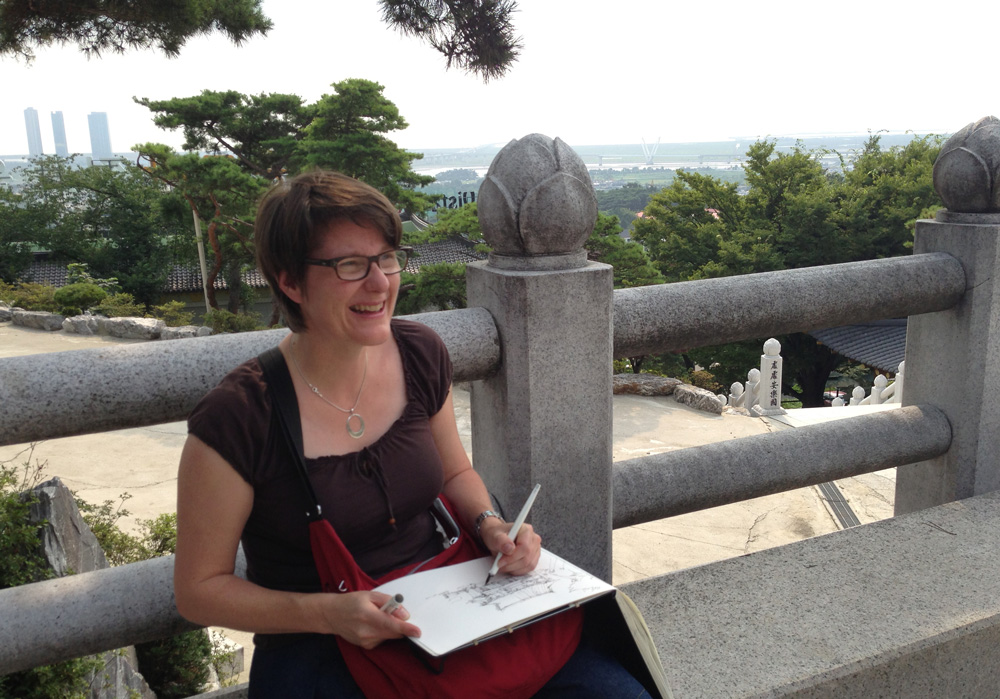
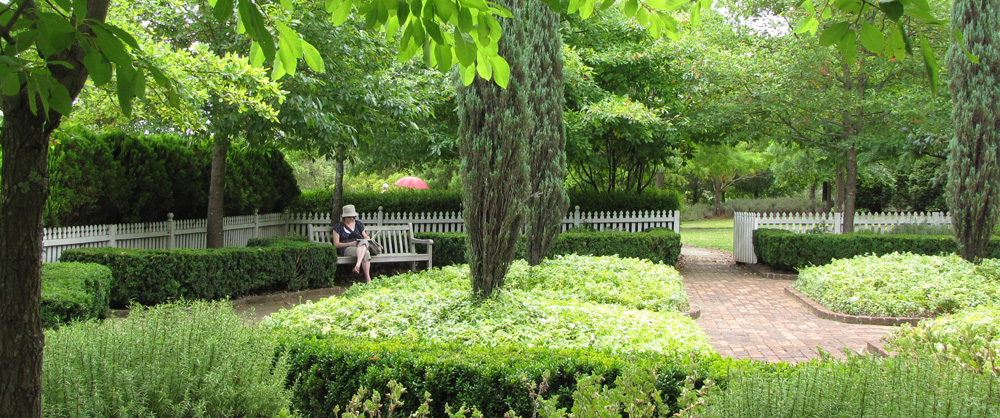
- Find a quiet spot where you can sit without people noticing you. A few starting ideas: a back corner, up against a wall, a bench in a quiet area of a park, or just sitting in your car!
- Look around and then find a simple object (such as a single tree, a chimney, a window, a simple building) to draw first. See FAQ 3 for more ideas!
- Don’t stress about getting it right – draw with strong, solid lines and embrace the wonkiness! Note: It’s better to draw with bold lines and embrace any mistakes than use tentative lines and try to get it perfect. This might be hard to accept, but trust me on this, okay? 🙂
- You’ll feel nervous, and your lines might be wobbly, but that’s totally fine! Don’t put any expectation on yourself to do a ’good’ sketch. Try to have fun observing your subject – this is the main thing!
- If someone notices you and comes up to speak to you, don’t freak out. Simply say you have just begun urban sketching, and you’ll be amazed by the encouragement you receive.
Once you have finished your sketch, write the date and your location on the page and…
Pat yourself on the back. Well done!
Repeat this another two times without any judgment on your work!
I’m serious, do it without criticism!
Then ask yourself:
- How do I feel?
- Did I enjoy being outside sketching?
- Do I feel more connected to the place I was?
Also, look at your sketches and ask yourself:
- What can I remember about my subject? Even if my sketch isn’t totally realistic, can I remember what it really looked like?
- Am I excited about the discoveries I made while drawing?
- Can I remember anything else that happened while I was sketching? Sounds, smells?
- Are there aspects of my sketch that I would do differently next time?
Do I want to keep doing this?
Hopefully, the answer is YES!
Okay, now we can start to talk about materials! 🙂
FAQ 2: What materials should I use?
Quick answer: It actually doesn’t matter – just keep it simple!
I’m guessing that you’ve seen lots of beautiful ink and watercolour urban sketches online, and that is what you want to achieve for yourself. I know that feeling exactly, as watercolour is – and will always remain – my favourite media for sketching!
But when we start, we need to keep it simple and feel good about our first steps.
So I recommend you don’t start with watercolour initially. (Wow! I know that this is a radical statement, but keep reading to find out what I recommend instead.)
Important Note: You don’t need to have the perfect tools to start. In fact, worrying too much about materials will become a barrier. The important thing is to fall in love with the act of sketching on location and to start your own creative journey!
All you need is:
i. a small sketchbook,
ii. a few basic drawing tools,
iii. a simple form of colour.
i. Small Sketchbook
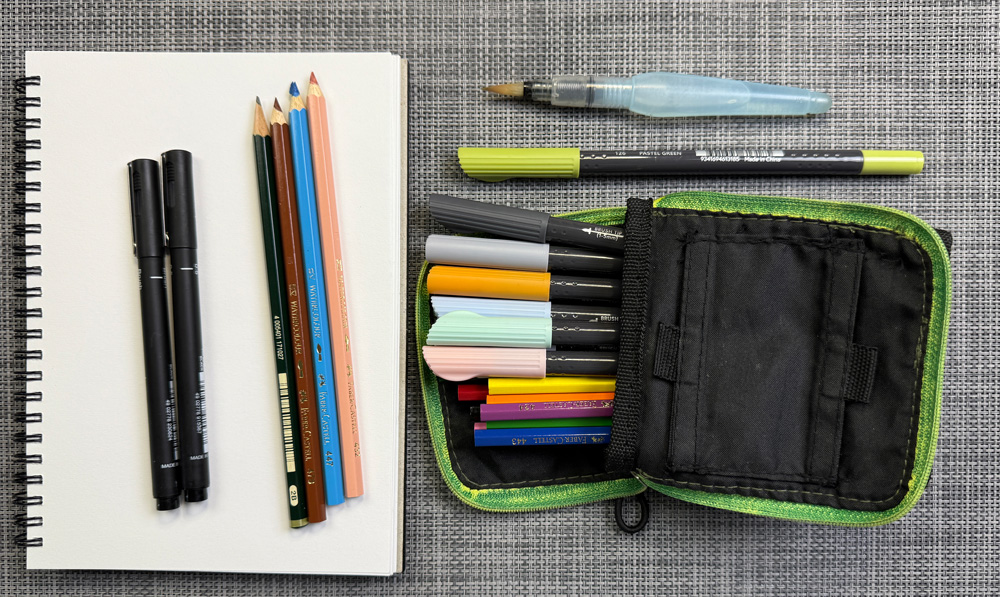
Any sketchbook (around A5 in size) will do! As we are not using watercolour, the paper doesn’t matter as much. Cartridge or drawing paper will work well.
It’s generally a good idea to start with an inexpensive sketchbook so you feel free to fill the pages with your early sketches. If you start with an expensive watercolour sketchbook, you’ll feel pressure not to waste it.
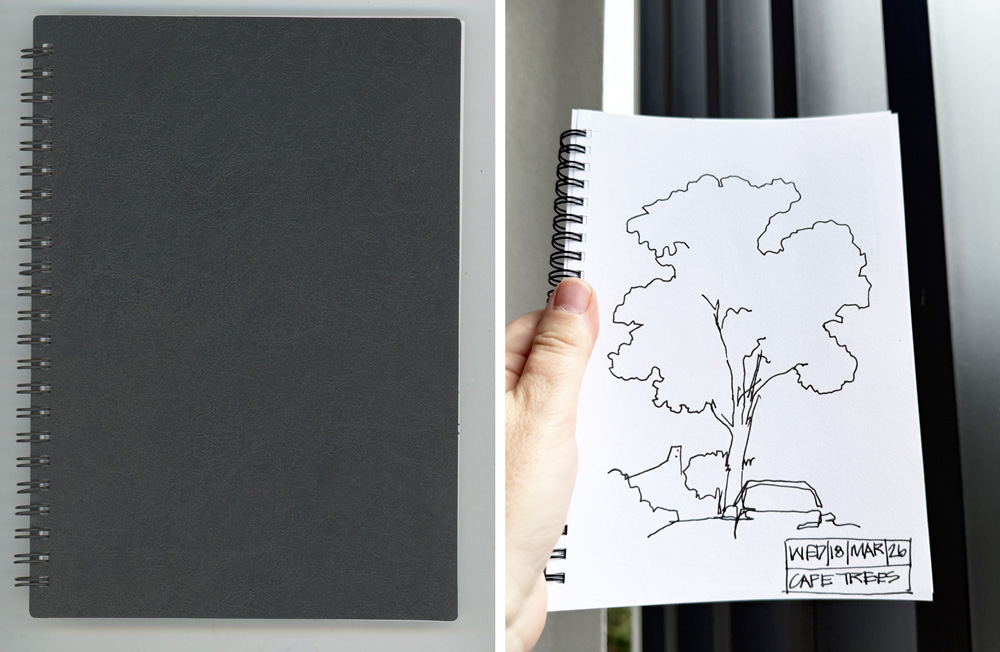
In preparation for this article, I filled a simple A5 spiral sketchbook (often called a visual diary here in Australia) with 110gsm cartridge paper. Note: Officeworks, Kmart, Big W etc all carry this style of book.
I worked only on one side of the page and folded the book back on itself when I was out sketching, making it comfortable to hold in my hand.
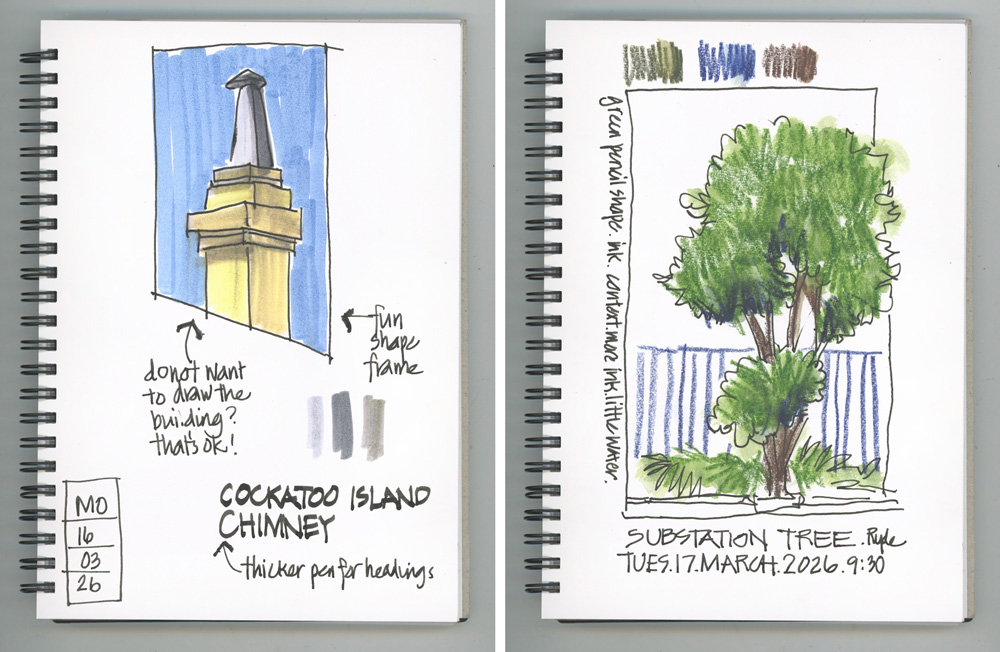
Cartridge paper (or drawing paper) is not suited to watercolour sketching, but you can add a little water to the page to activate watercolour pencils or soften water-soluble markers.
ii. Basic Drawing Tools
You can use any pen or pencil when you are starting. The main goal is just to get outside and start developing your observational skills
However, if you want some general recommendations…
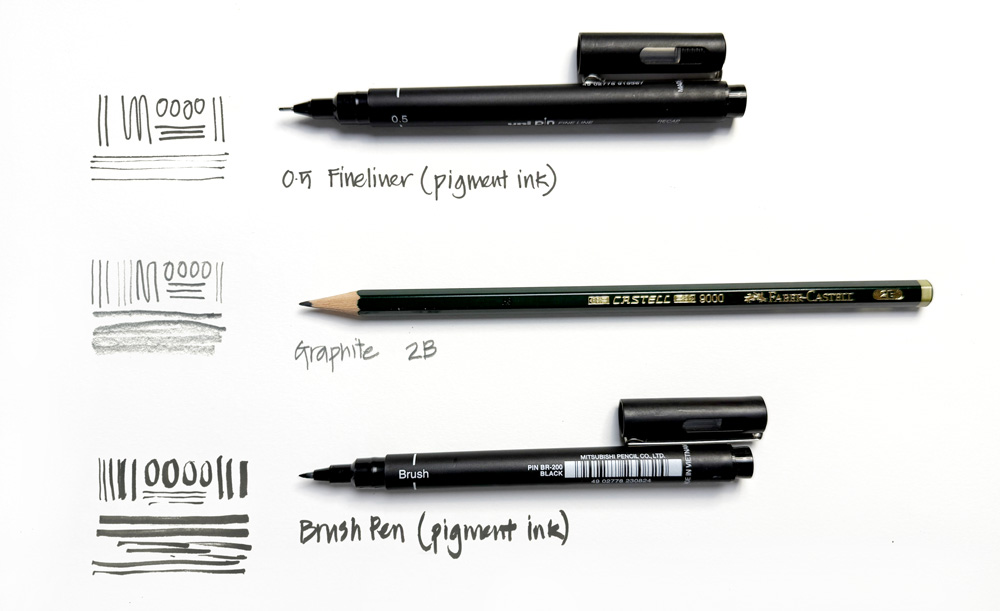
Here are three drawing tools that I like to use:
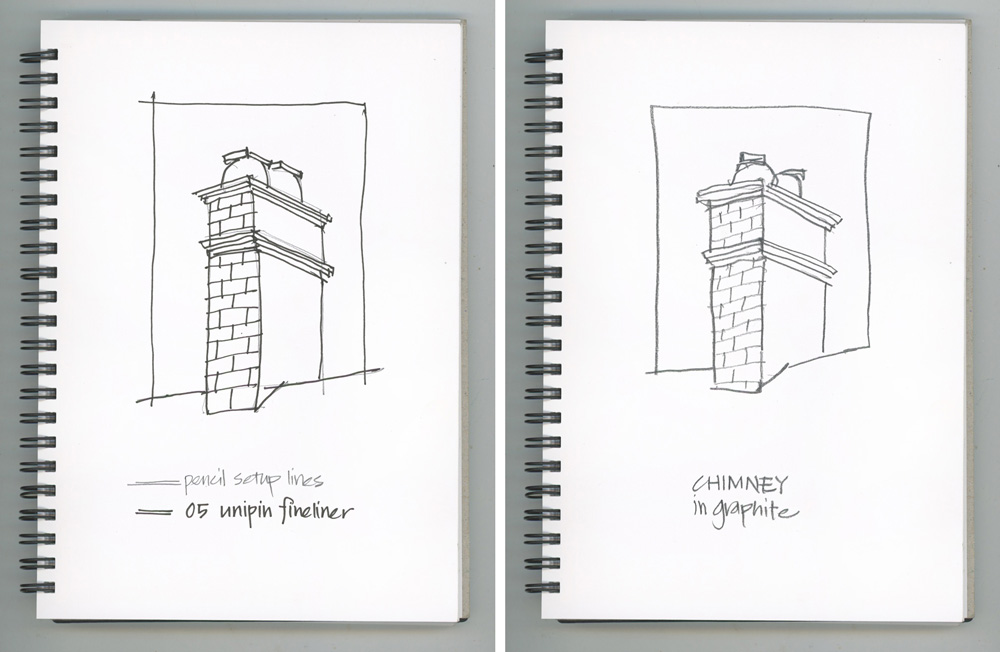
- Fineliner: Look for a permanent fineliner (Unipin, Micron) as this will enable you to add a little water over the top down the track. I recommend a 0.5 or 0.3 tip (not too fine). See this article for further fineliner recommendations.
- Graphite Pencil: Any brand of pencil will do. I like 2B as it’s soft but not too smudgy. You might find a mechanical pencil is very convenient for keeping your lead sharp.
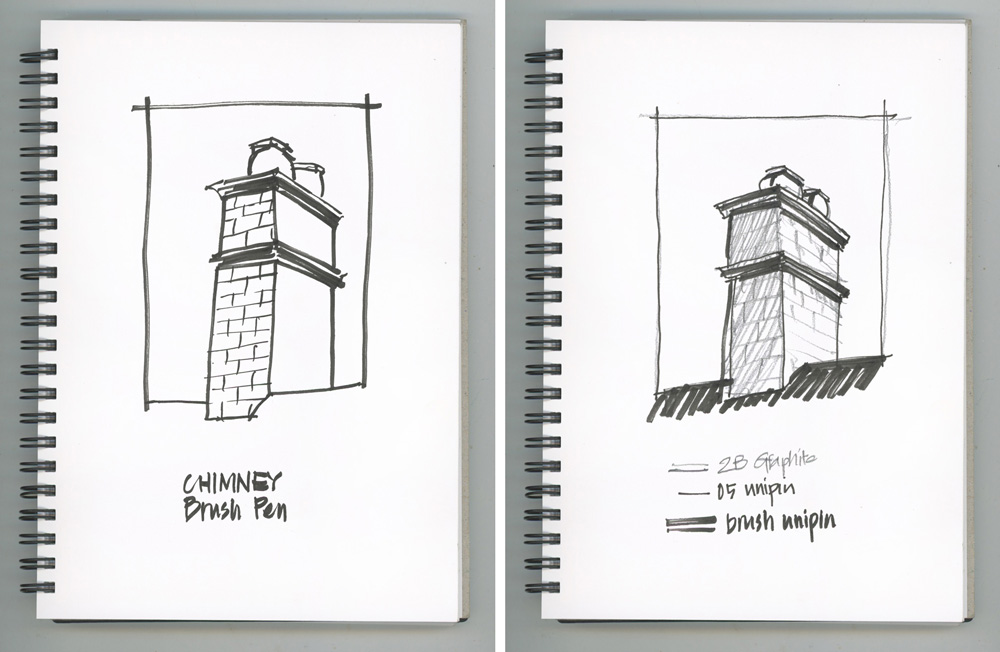
- Brush Pen: This type of pen is totally optional, but I like having a permanent ink brush marker for thicker, variable lines. They are also great for infilling black shapes. Options: Unipin Brush Pen (pictured above), Faber Castell Pitt Brush Pen and Tombow Fudenosuke Brush Pen. Note: The Fudenosuke Pen is the easiest to use as it has the firmest tip – see here on Amazon.
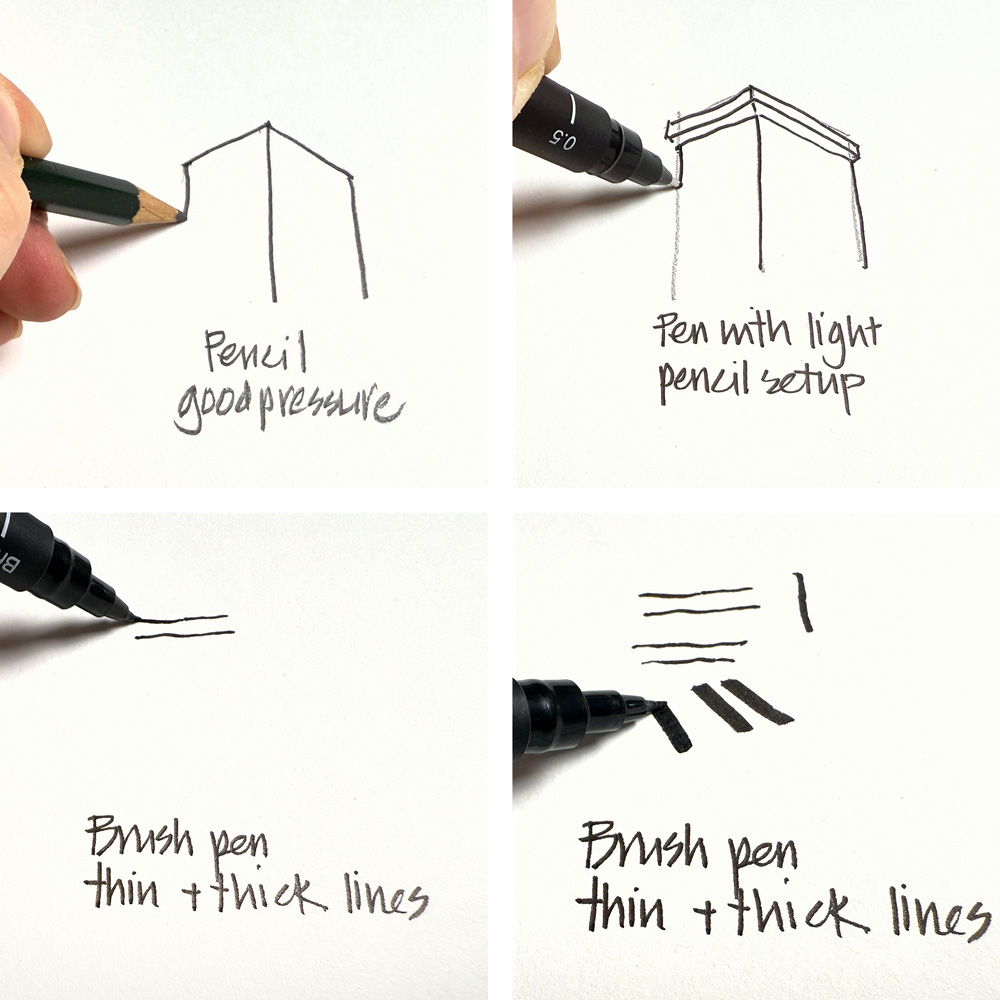
A few tips for drawing:
- Work slowly and don’t draw too large.
- Draw strong, bold lines rather than hesitant ones. It’s okay to draw a few pencil lines first (for setup), but don’t draw everything in pencil – just the main outlines.
- Don’t worry if you draw a line in the wrong place – keep going. Embrace the wonkiness!
- If using graphite, draw with a good amount of pressure so that your pencil lines are bold. (Use a pencil as if it’s a pen!)
- The Brush Pen lines will be thicker and bolder than the fineliner, making it handy for quick sketches. Use the pen on its side for thicker lines.
- You can use all three tools in one sketch.
iii. Simple Colour
It is best to focus on basic drawing skills at the beginning, but adding colour to our pages will make them more exciting!
Here are my recommendations for a simple approach to colour.
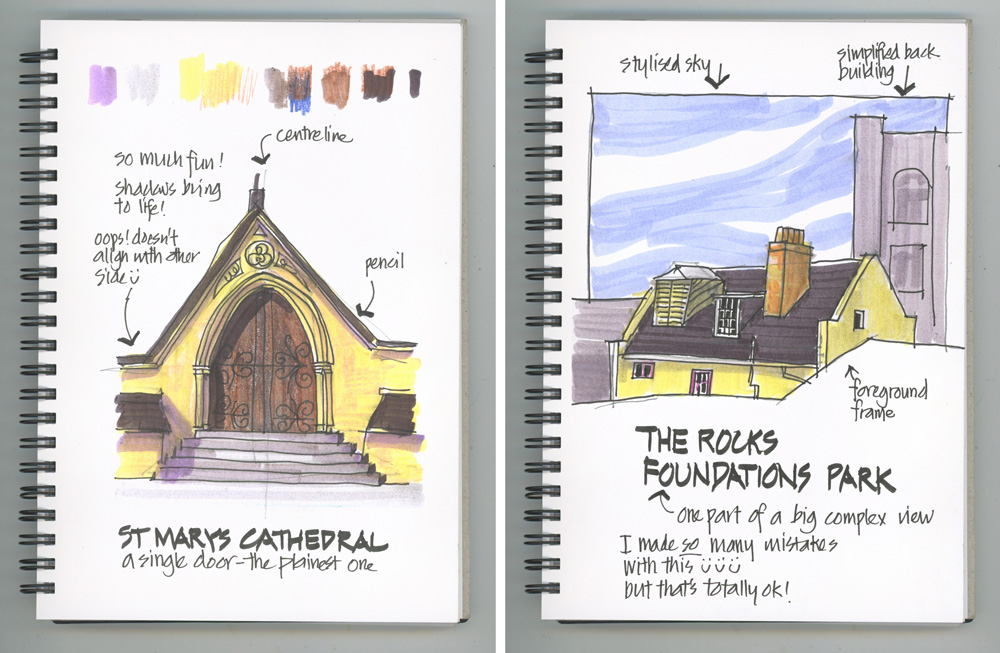
Rather than using watercolour (which has a super steep learning curve), I suggest you try some watercolour pencils or water-soluble markers… or both!
The goal is not to create realistic full-colour sketches, but to have fun (remember Mindset 2) with a little colour.
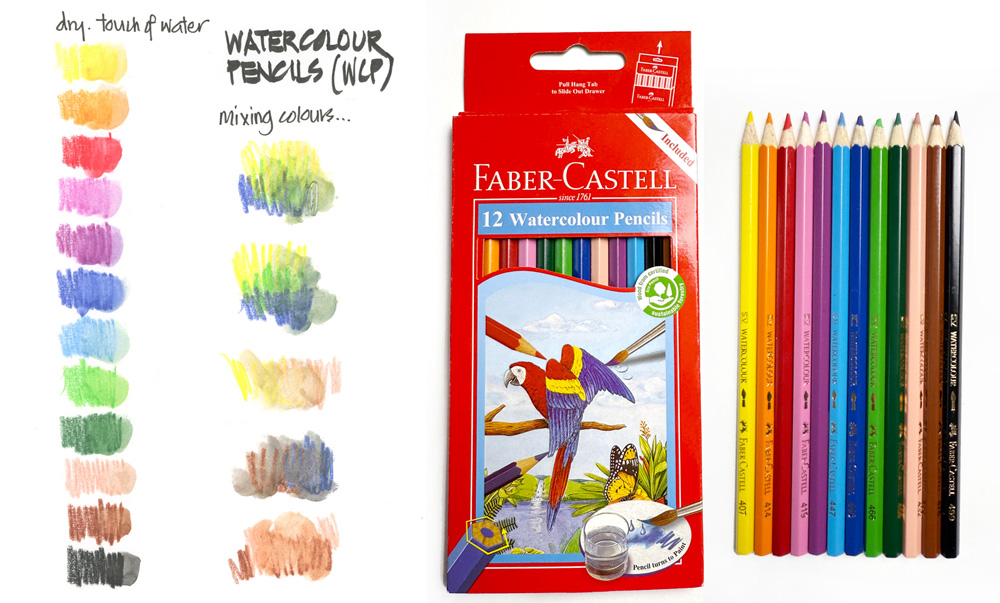
Watercolour Pencils
I generally use Faber-Castell’s Artist Grade Albrecht Dürer watercolour pencils and have some recommended colours, see here.
But when you are starting, any set will do. Please note: Artist-grade pencils are significantly nicer to use than student-grade pencils.
There are two student grade options within the Faber-Castell range: Goldfaber Aqua Pencils and Red Label Watercolour Pencils (these are readily available in Australia) The Goldfaber are nicer than the Red Label, but either set works fine. (I used the Red Label for sketches in this article.)
You can use watercolour pencils either dry or soften them with a little water. A waterbrush is a convenient way to do this – find out more about them here. In the above image, you can see the colours of the 12 set, both dry and softened with water.
You’ll also see that I did some mixing tests as well. 🙂
Water-soluble Markers
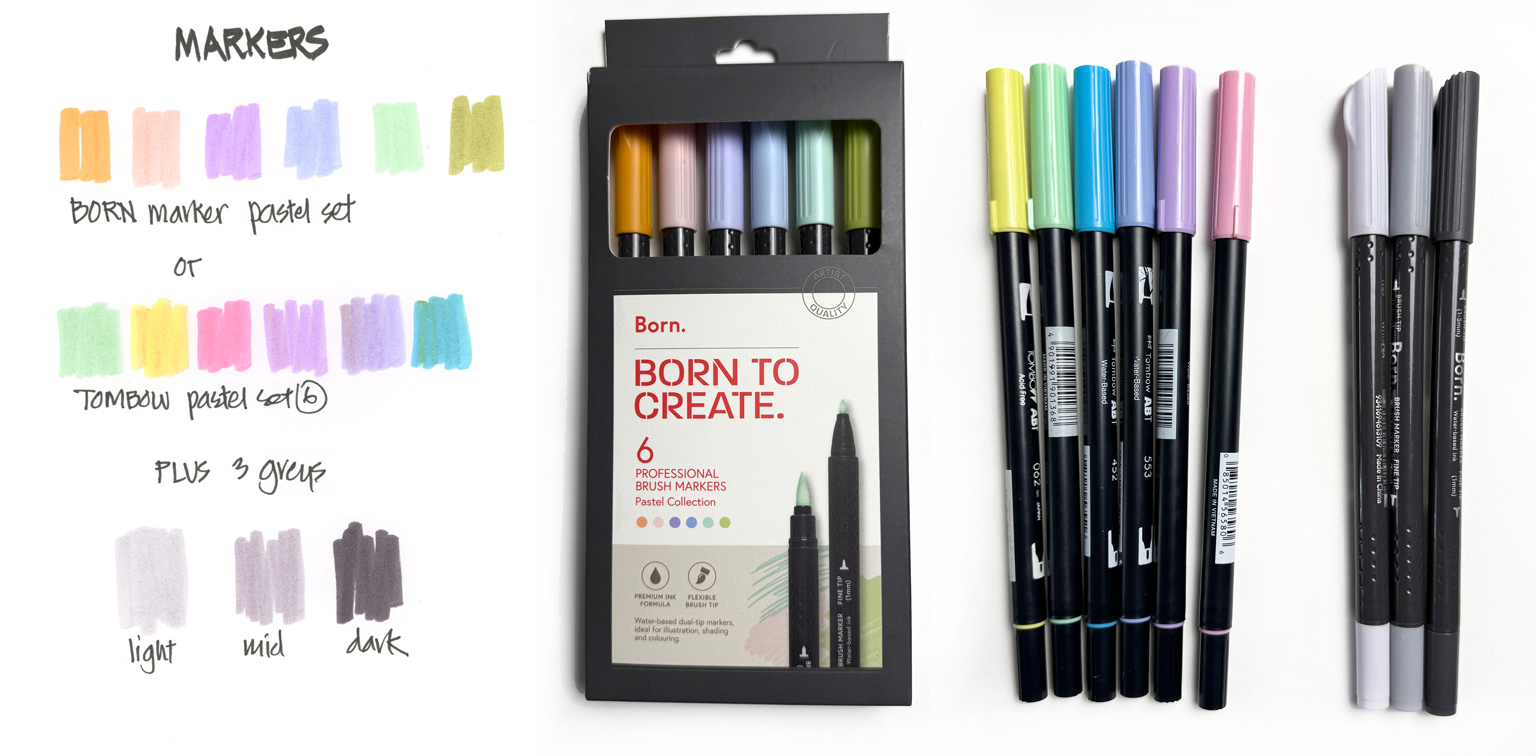
I also like using a few markers (such as Tombows ABT water-soluble markers or Born Professional Brush Markers – available in Officeworks or Kmart in Australia.)
There are no marker sets available at the moment with a good range of colours, but I recommend looking for a pastel set. Here is a link to the Born set pictured above. And then add three grey markers (light, mid and dark).
As the basic watercolour pencil set is full of strong colours, a few light pastel markers complement them well.
Some colour tips to get you started:
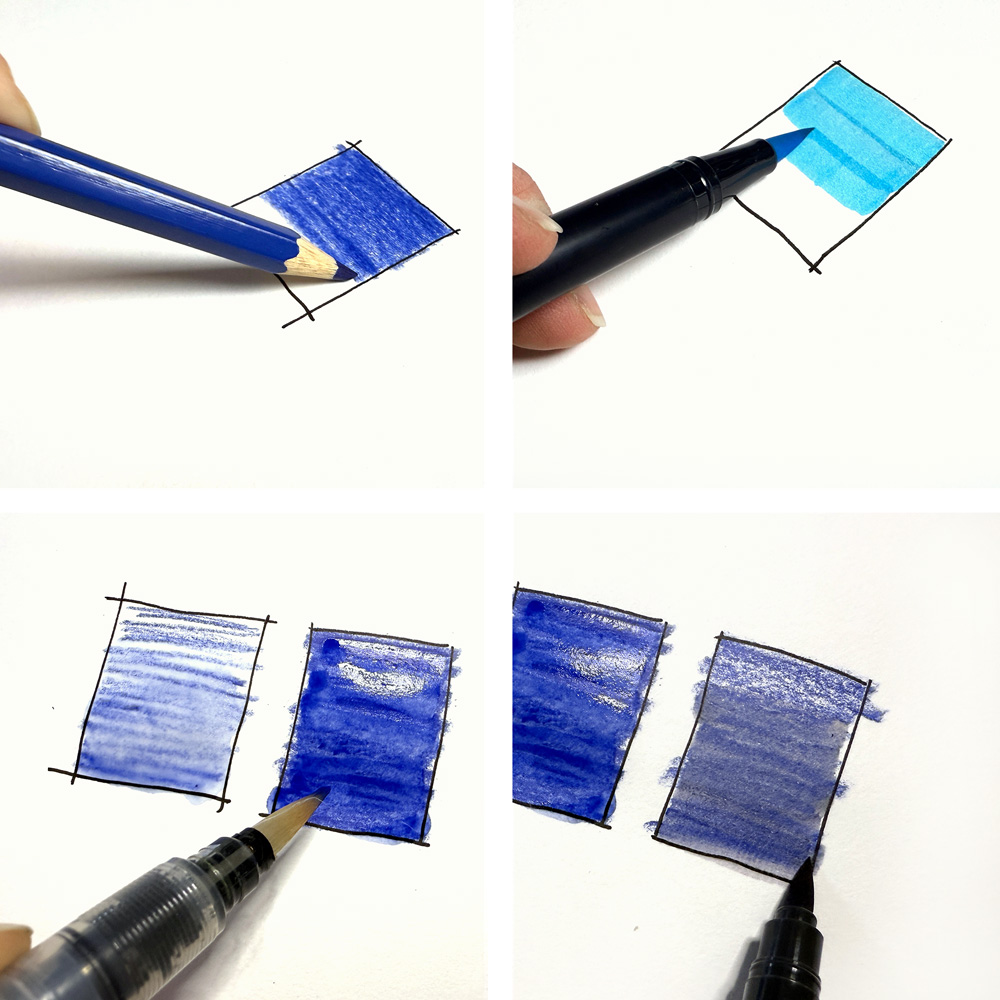
- For sketching, I recommend using fairly heavy pressure when adding colour with watercolour pencils so that you achieve a solid block of colour (This is different from standard colour pencil techniques, which involve building up multiple layers with light pressure).
- Apply colour using the side of the marker tip and fill shapes with long straight strokes. There will be some stroke overlap, but that’s ok. Refer to my sketches in this article for examples of this.
- If you want a completely smooth, solid colour with watercolour pencils, add a little water using a waterbrush.
- You can also add marker over watercolour pencil. Note: This does pick up a little of the pencil colour, but it’s easy to clean the marker tip with a few strokes on a scrap piece of paper. I use this technique all the time!
- Work out which colours from your sets are light, mid, and dark, and then start thinking about whether the colour you see is light, mid, or dark. For example, if a tree is green, consider whether the overall colour is light, mid, or dark, and then observe which areas are lighter and which are darker. (Note: This is a simplified way of thinking about value or tone.)
- Don’t worry too much about matching colours exactly. If you are using student-grade pencils, there will be some bright colours in the set so using more of your light colours (whether pencil or marker) will help with this.
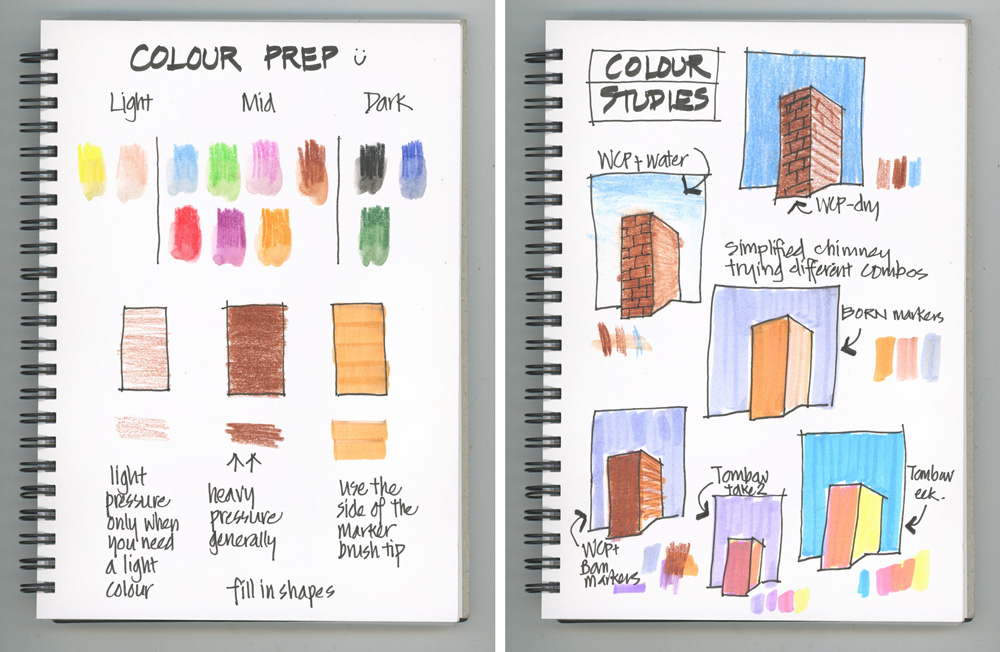
Do some colour experiments to see what range of colours you can get with your pencils and markers. You can see that it takes me a few goes to find a combination of colours I like.
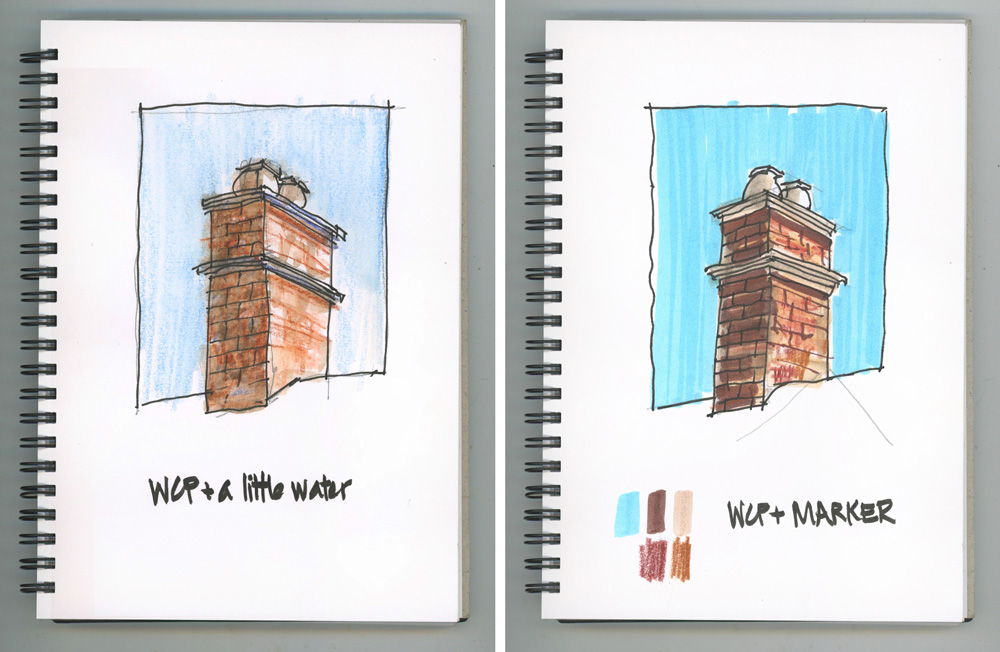
Here are those techniques in action.
Reminder – if you are going to use water to soften watercolour pencils, just lightly touch the pencil stroke with a damp brush. Don’t use too much water.
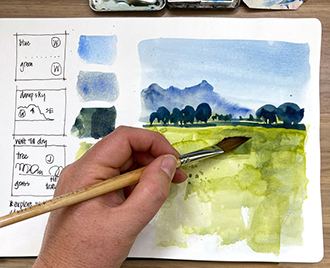
A little more about watercolour
As mentioned above, I LOVE watercolour – nothing can match the wonderful, lively effects you get when using it.
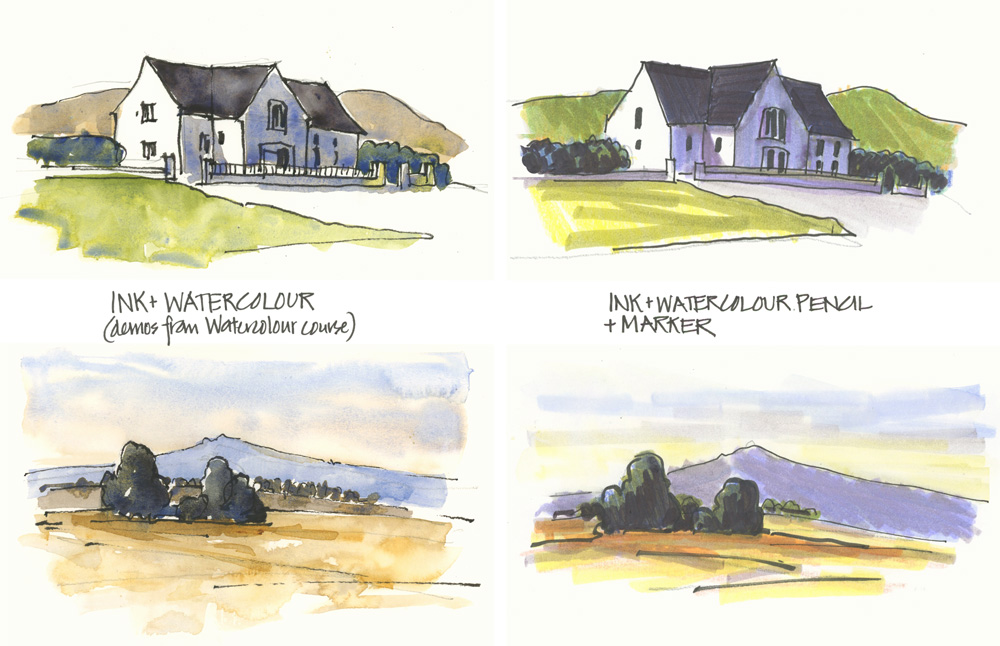
Simple sketches such as these (above on the left), which were done during livestreams inside my Watercolour course, make it look easy… but it is harder than you think to achieve these seemingly effortless results. 🙂
You have to mix the right ratio of pigment and water in your washes (and use specific pigments), apply the paint confidently, and then let it dry without fiddling. You also have to think about value (whether the wash will dry light, mid or dark), hue, temperature and brush strokes. So to get the best results with watercolour, you have to be bold and think about a lot of things at the same time. It’s totally worth it in the long run, but it is a lot when you are just starting out!
Working with dry or quick-drying media (such as watercolour pencils or markers) is much more forgiving. You’re able to think about one aspect of colour at a time and progressively build up your sketch in a more controlled way. There is much less risk of overworking. So using watercolour pencils and markers is a great way to start developing your sketching skills.
Using colour is a big topic, but I hope that these tips are enough to get you started!
FAQ3: What should I sketch?
Quick answer: Sketch simple objects and start small.
You don’t need to travel or live in a beautiful part of the world – just start sketching everyday things, and you’ll soon discover that there are beautiful edges, shapes and volumes everywhere.
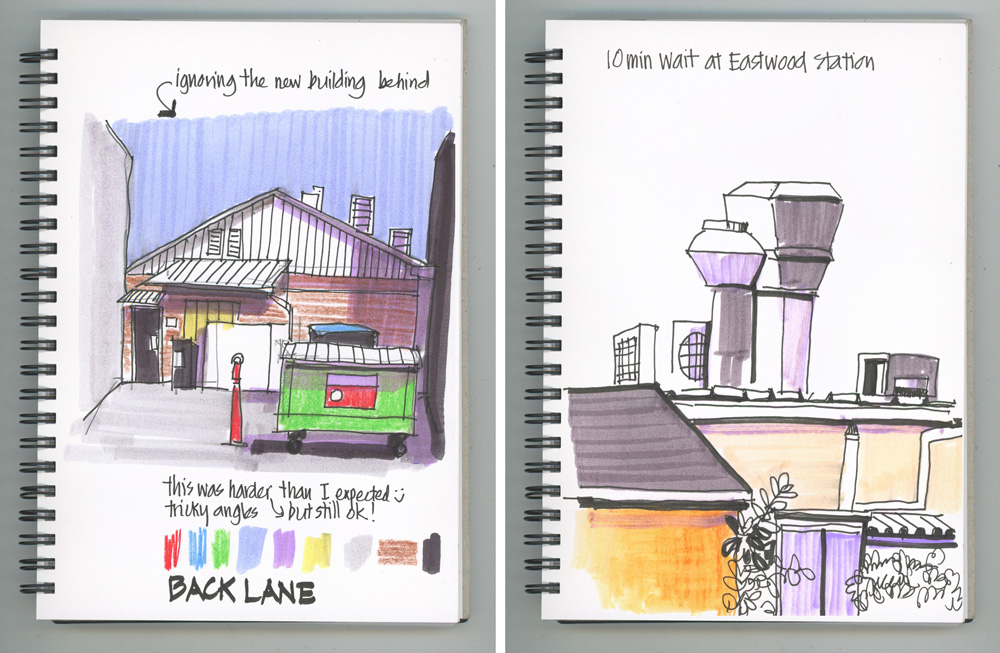
In fact back lanes and the rear of buildings make really fun subjects to sketch!
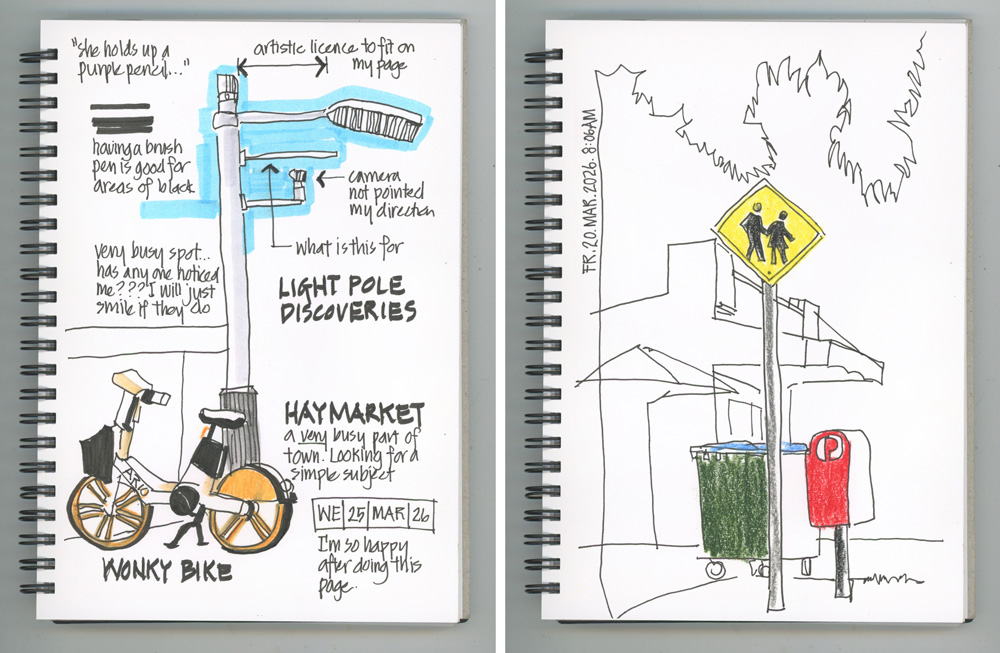
Make sure you start small – don’t pick complex scenes to begin with – look for single objects or scenes with big, simple shapes.
Some suggestions for simple subjects
- a single tree
- a pot plant or a flower pot
- a fence or gate
- a simple house or small building
- a clock tower or church steeple (don’t have to do the whole building)
- a chimney
- a door or window
- a letterbox
- street furniture – a sign, a phone box (do they still exist?), a garbage bin, a traffic line, a lamppost, a fire hydrant
- items on a cafe table (sugar, salt and pepper) or your coffee!
- a car, a truck, a scooter, a bicycle (remember to ’embrace the wonkiness’)
- the back of a shop with ducts and pipes
- a chair or bench
- simple shapes for people.
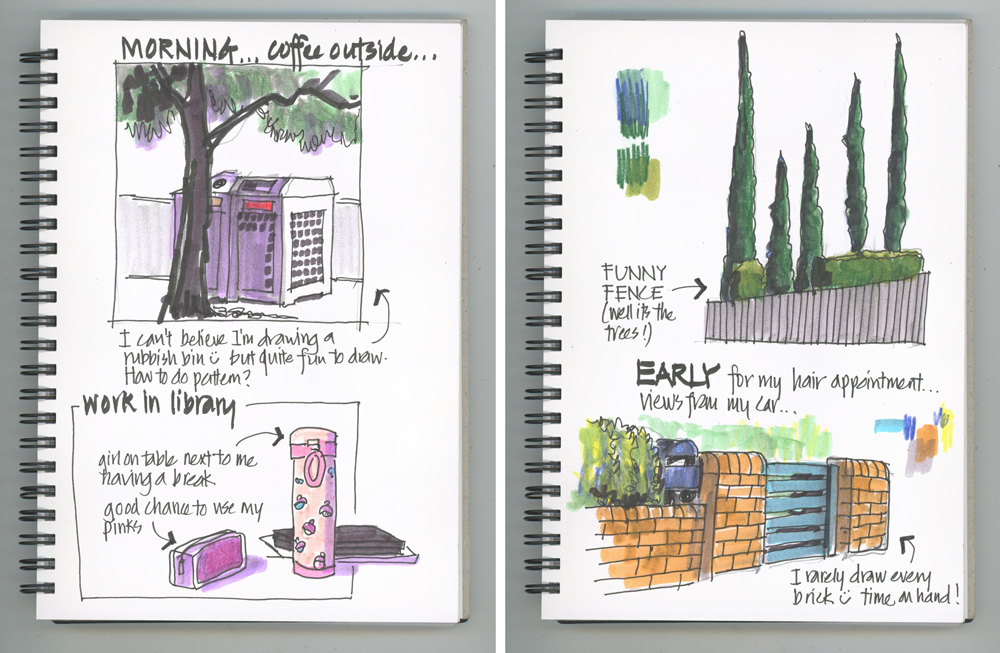
You can find lots of little moments from your day to sketch!
Combine them on a page together and you have a very special narrative of your life (Mindset 3).
FAQ 4: How can I become more comfortable sketching in public?
Quick answer: Keep doing it 🙂
It becomes easier over time, but you have to push through the initial fear. You’ll soon become addicted to sketching on location!
Here are some tips and thoughts:
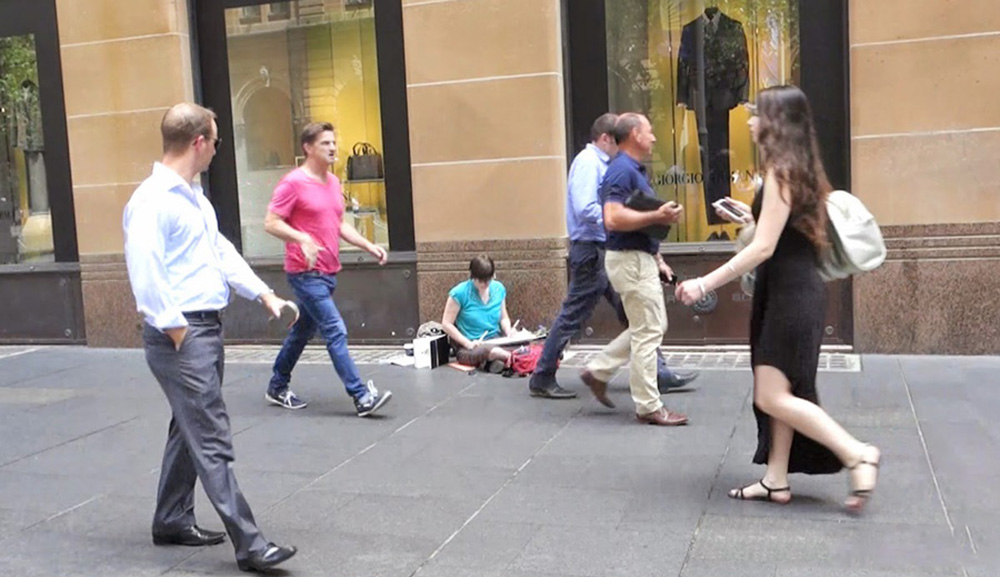
- It might feel scary to sketch out in public, but the reality is that most people will not notice you at all!
- If you can find a spot up against a wall, very few people will disturb you.
- Bring a friend with you (even if they are not sketching too). Having a friend sitting next to you, reading or scrolling their phone, is great moral support! If someone does approach you, they can also do most of the talking, so you can more quickly get back to your sketch!
- If someone notices you and stops to say something or have a look… Say hello with a smile. Explain that you are learning to sketch on location and that it’s fun! (Be more confident about your work than you feel and try not to be too critical of your sketch!) And hey! I’m totally happy for you to blame me: “I’m doing what Liz Steel says!”
Sketching on location is special, not only because people can stop and talk to you but also because a few things will nearly always happen…
- If there is a free spot in front of you, a truck will park in front and block your view 🙂
- As soon as you start drawing someone in a cafe who looks settled, they will get up and leave 🙂
- If you are drawing a house, the owner will come out, and then you will have to decide whether to try to hide or say hello to them 🙂
- The shadows at the start of your sketch will not be the same at the end (this one will actually happen every time you sketch!)
As mentioned earlier in Mindset 2, these challenges are all part of the fun!
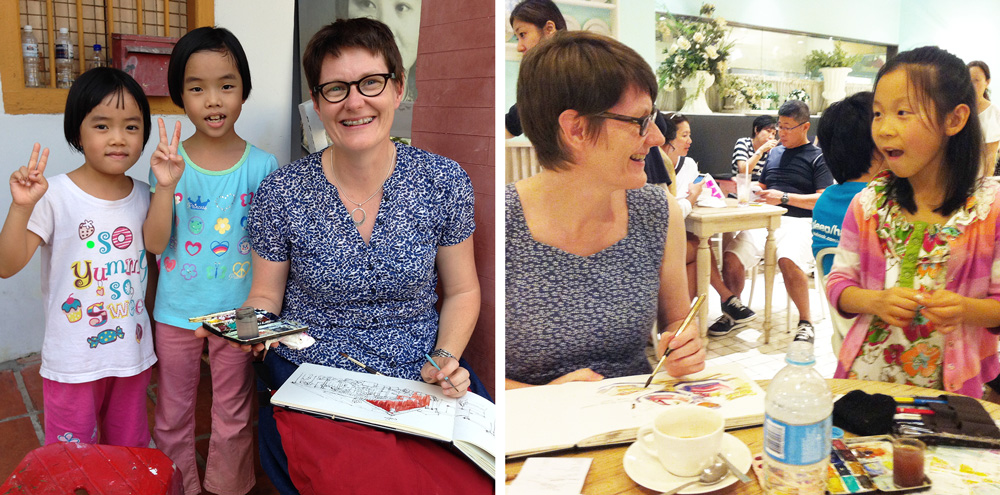
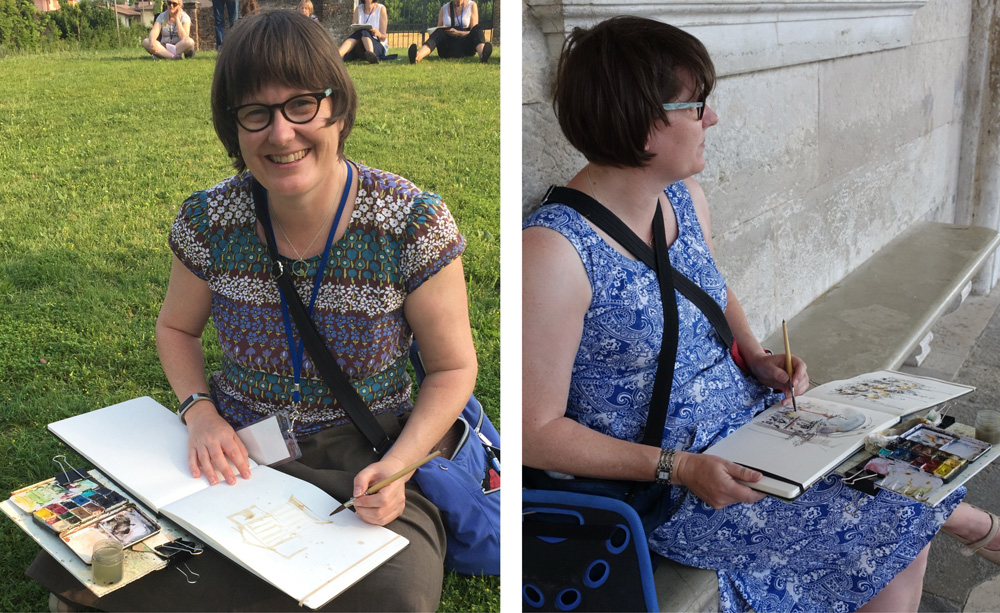
Interacting with other people might seem scary when you first start, but I can guarantee that once you have gained a bit of confidence, these short conversations while sketching are the best part of being out on location. I mean, how could you not want to talk to these sweet girls? 🙂
Here are some more tips from my blog readers.
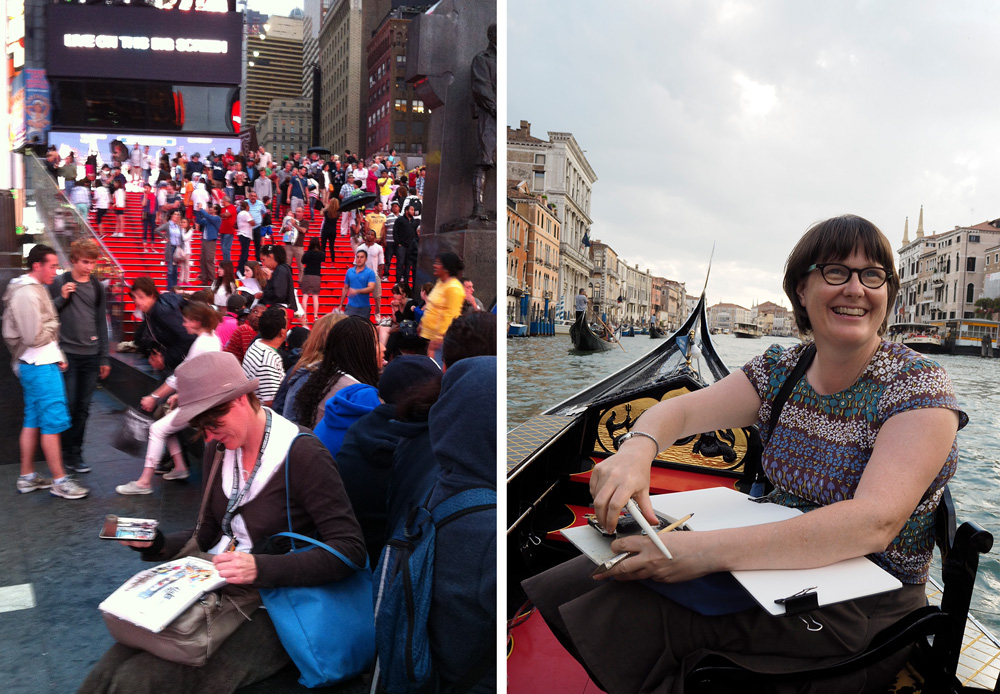
And then once you become more confident, you might find yourself doing crazy things – like sketching in Times Square, NYC, on a wet Friday night or during an all-too-brief gondola ride in Venice!
It’s fun to see how the adrenaline rush from these kinds of sketching adventures is translated into your strokes on the page.
FAQ 5. How do I get better at sketching?
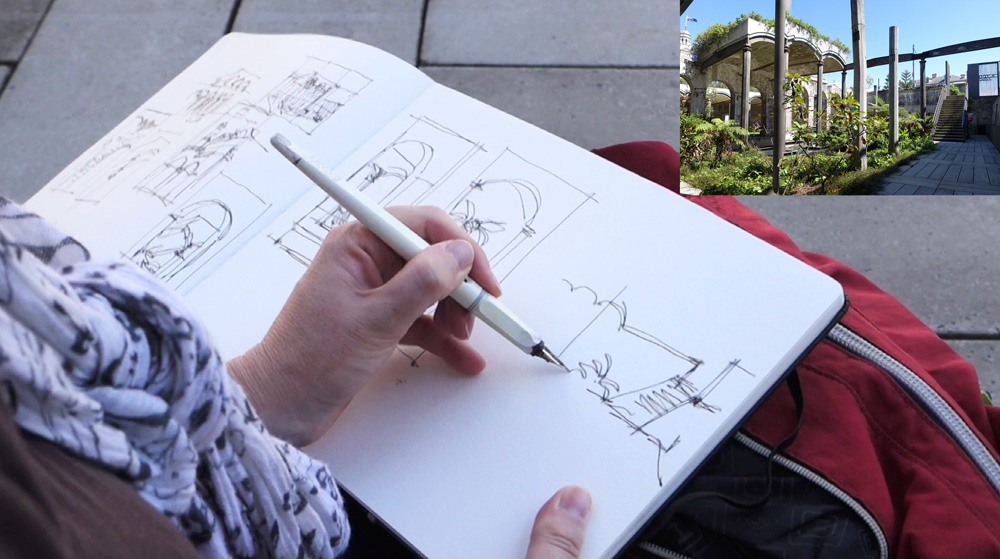
Quick answer: Focus on building core observational skills
The goal of this article is to inspire you to get outside and sketch, and to fall in love with sketching on location because…
If you can start enjoying the experience and journey, the learning process becomes much easier!
But of course, once you start sketching on location, you’ll be constantly asking yourself, “How do you sketch [fill in the blank]?”
Our natural tendency is to want a formula to follow: “This is how you draw [fill in the blank]”, because that is how we were taught to draw as children.
But the most fundamental drawing skill to develop is to think (and see) differently!
We have to learn to stop thinking about our subject in terms of objects (what I call using our ‘object brain’) and start observing it as a series of interconnected edges. Once we learn to see everything as edges, we can draw anything!
And then the next step is to simplify complex scenes into a series of big shapes and underlying volumes.
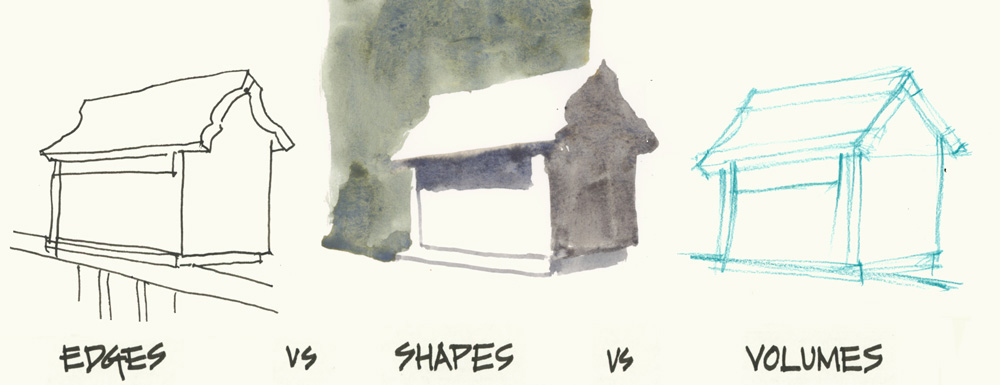
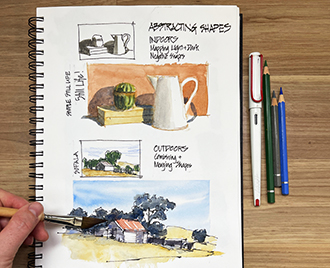
Feeling Edges, Abstracting Shapes, and Constructing Volumes are the key concepts in my Foundations online course.
This is the course I developed specifically for beginners, and I have some free lessons to introduce these main concepts to you.
Yes! I want these free lessons!
If you have been sketching for a while and have a specific area of your sketching that you want to develop, please check out my How to Improve Your Urban Sketching page here.
I hope you have found this page helpful and are excited to get out sketching on location!
Any questions? Please get in touch via the contact form here and ask away!