It can seem a little overwhelming to start sketching on location.
It’s easy to get bogged down by thinking you need to buy lots of new art supplies or have the “perfect” sketching kit. Maybe you worry you need to know how to sketch everything before you go on location.
But creating art is as much a mental activity as it is doing something with your hand. And the fear of sketching in public can become a huge barrier to getting started.
And so before going out on location, it’s important to start thinking in a way which will make it easier.
Here are three essential mindsets for sketching on location:
- Mindset 1. Focus on the experience, not the result!
- Mindset 2: Focus on enjoyment, not perfection
- Mindset 3. Focus on the journey, not the individual sketch
Note: This article is an expanded version of the three mindsets shared in my How to start urban sketching page.
Mindset 1. Focus on the experience, not the result!
Here are four ideas that will make sketching on location easier…
Focus on the act of discovery
Learn to see the world in a new way and start seeing beauty everywhere. Any scene (including ‘ugly’ everyday places) can become interesting once you start looking at it in a visual way – once you start seeing things in terms of edges, shapes and volumes. (This is what my Foundations course is all about!)
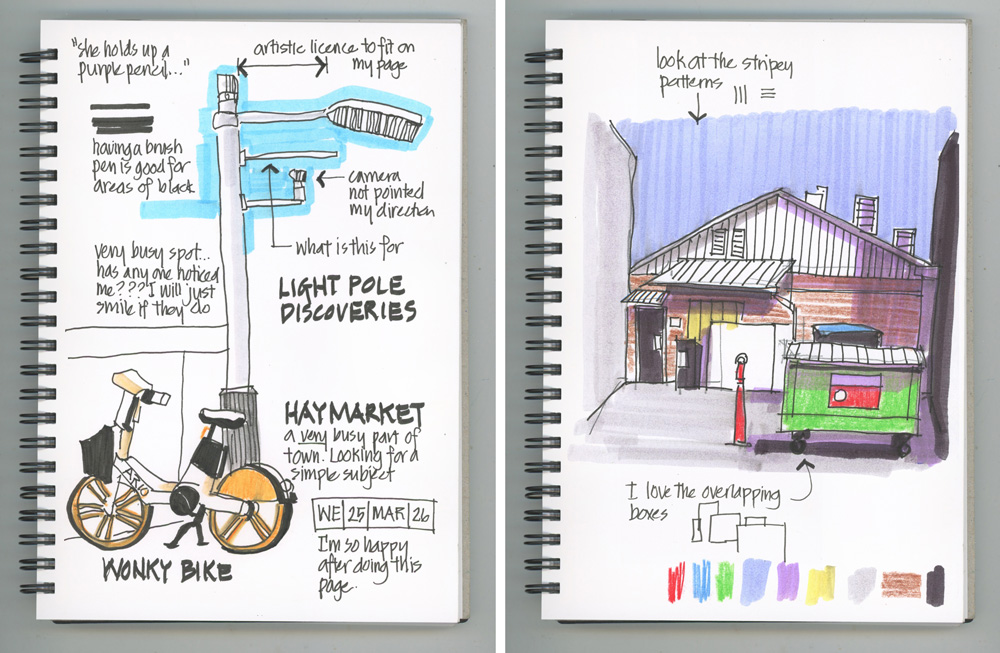
You’ll discover new aspects of your subject. For example, in the above left sketch, I got excited about all the various parts of the street light pole at Haymarket!
And you’ll also notice abstract things such as the patterns of horizontal and vertical lines or the overlapping rectangles in the above right sketch. Sometimes this type of discovery happens while you are in the middle of your sketch.
Get excited about these kinds of insights rather than stressing about your sketch. The discovery is more important than the sketch!
Focus on the internal dialogue between your eyes, your brain and your hand
As your eye traces the edges of your subject and your pen moves across your page, start a conversation in your head about what you are drawing in terms of edges: ‘how long is this edge, what angle is it going at, where do these two lines intersect?’
If you focus on this dialogue, you’ll become less worried about how good your sketch is.
You’ll also no longer worry about other people walking past!
In a mysterious way, the buzz of the world around you can make your internal dialogue clearer in a similar way that the white noise of a busy cafe helps you concentrate on your work.
Note: I found this to be the case when I was doing the light pole sketch above in a very busy part of Sydney – refer to my notes written on the page at the time. Only occasionally, when I paused from my sketch, was I conscious of the conversations of people walking past.
Focus on your own personal interpretation
You don’t have to draw everything! Just ask yourself, ‘what interests me?’ and start your sketch there.
A simple drawing of one part of a complex scene is enough to create a powerful memory of your sketching adventure.
Using the light pole sketch again as an example, I was in a very busy intersection in Haymarket, Sydney, and all I chose to sketch was a light pole and a single bike – but I can remember so much more about this experience.
Accept the challenges of being on location as a fun part of the experience
I’m not denying that it can feel scary when you start sketching in public, but once you push through that initial fear, you’ll become addicted (in a good way!) to the creative buzz that comes from urban sketching.
Instead of being afraid of people stopping, you’ll find that brief interactions while sketching become the highlight of any sketching excursion. These conversations are nearly always super positive and encouraging!
There are so many external conditions that you can’t control when sketching on location. The weather might change, a truck might block your view and people might stop to say something nice about your sketch.
It’s good to lean into these unexpected challenges and turn any annoyances into funny stories! And focus on these narratives rather than the ‘negative’ impact they had on your drawing.
Which leads to the next important mindset…
Mindset 2: Focus on enjoyment, not perfection
Most people find that their ‘inner critic’ becomes active when they start drawing.
This internal voice can become very critical of our drawings, leading to frustration and discouragement. We might give up too early and miss out on the chance to have a cool finished sketch. We might focus only on the mistakes and miss all the good parts of our sketch. We might feel discouraged and think we will never improve. (And that is not the case! Anyone can learn the basic observational skills needed to do a fun sketch as I teach in my Foundations course!)
The best strategy to deal with our inner critic is to make friends with it
When we are just starting, I recommend that we tell our inner critic: ‘I’m a beginner, and at this stage I want to have fun. I’m not trying to create perfect results.‘
Hopefully, this will be enough to quieten our inner critic and help us push through.
(See more about the dialogues I have with my inner critic here).
Learn to accept mistakes as part of the drawing process
Some people don’t like using the term “mistakes,” but my inner critic uses the word all the time and loves magnifying them! And I guess that this is the same for everyone.
If we want our sketches to look believable (reasonably realistic), then every time we draw a line in a place that doesn’t match how it appears from our point of view, it can be seen as a mistake. If we add too much heavy colour or overwork our watercolour washes, leading to a flat and heavy result, that can also be called a mistake.
Focusing on the more positive internal dialogue of seeing our subject as edges, shapes and volumes (as we mentioned in Mindset 1) not only shifts the emphasis away from our inner critical conversation but it also lessens the impact of mistakes.
But the reality is that every time we start a sketch, there is always a potential for mistakes – no matter how experienced you are! Over time, we learn how to reduce the risk for common mistakes (ie, slow down and more carefully observe our subject) and develop strategies for fixing mistakes. We no longer become afraid of them!
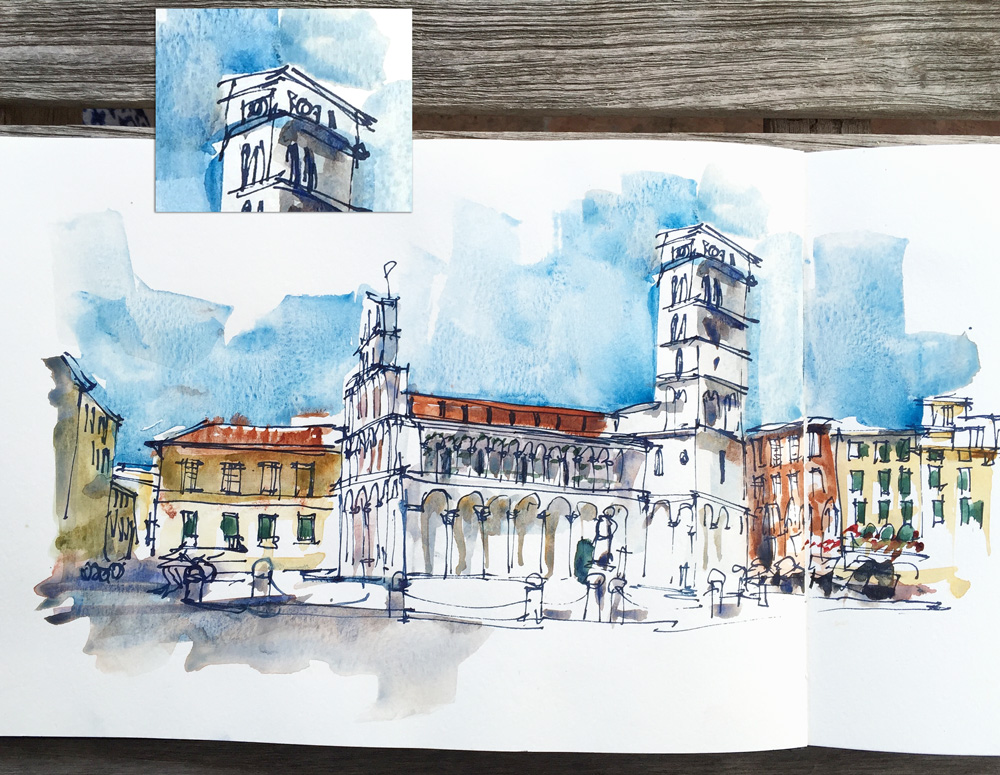
The sketch of San Michele in Lucca, Italy, above is a good example of a mistake that isn’t really visible in the final result. I initially made the tower too short (notice the blue-painted line in the detailed inset), but I was working in a way that hid that fact.
We can’t gauge a sketch’s success at the time
When we are still on location, looking at our subject, all we see in our sketch are the things that didn’t turn out as we expected. But if we create some distance (in time or space) from our subject the more we can see good things about our sketch. Our sketches always look better the next day!
Mistakes are an inherent part of sketching, so the more we can go with the flow and enjoy the process, the better. Our sketches will have a joy and liveliness about them, which is way more important than technical accuracy.
So let go of perfectionism and ‘embrace the wonkiness.’
Mindset 3. Focus on the journey, not the individual sketch
And finally, here are three ideas to help you think bigger!
Don’t put pressure on yourself to do a ‘good’ sketch and don’t be discouraged by your first drawings
And don’t ever refer to them as ‘bad’ (That’s the inner critic talking!)
Instead, remind yourself that you are just starting and are on a creative journey. Each sketch is a stepping stone to the next stage.
Focus on the next step
You are building your skills, and every sketch is part of that process. If you are not happy with your sketch, don’t let your inner critic take over (Mindset 2 again!). Instead, think about what you’ll do differently next time and what you want to research and explore further.
Don’t put any time pressure on yourself – just take your time and enjoy every step.
If you add a date and location to your sketch, it becomes part of something bigger
You will be creating a visual narrative of your life!
This shifts the emphasis from the quality of the individual sketch to the moment you are capturing. Over time, this record of your creative journey is also a collection of memories of your daily life.
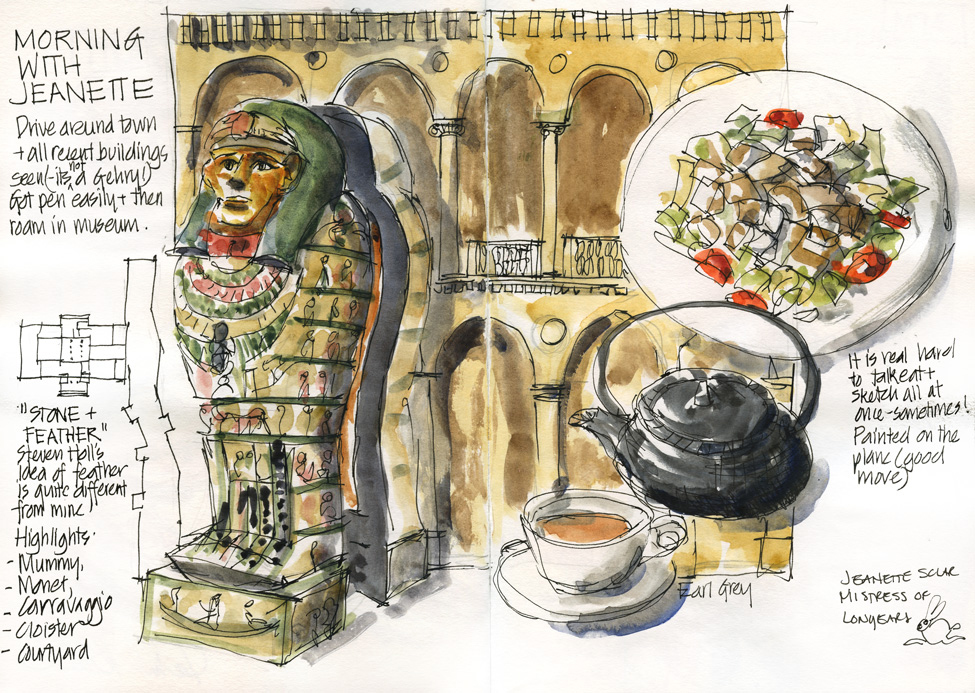
Note: The above sketchbook spread from a visit to The Museum of Kansas City is full of rushed sketches that I wasn’t particularly happy with at the time. But the addition of some notes and a background coloured shape has resulted in a very special page recording a lovely day with a sketching friend.
I can’t stress enough how important it is to have a positive mindset when you start sketching on location!
There will be many moments when you feel unhappy with what’s on your page, so you need to be able to push through and focus on the more fun aspects. And amazingly, you’ll discover that the sketches that are most frustrating at the time often become your favourites!
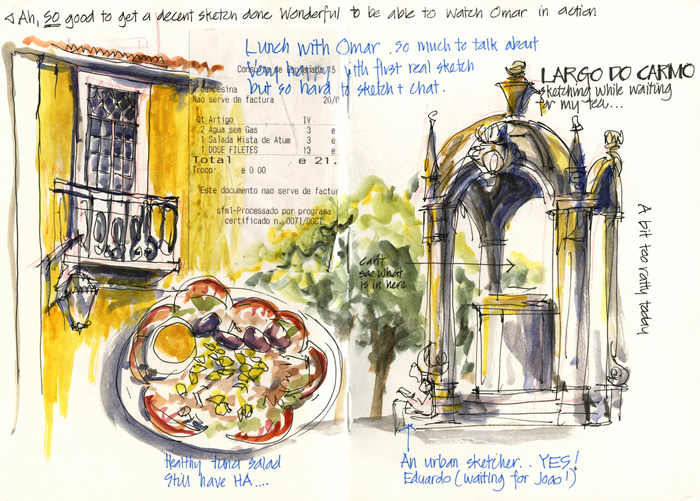
For example: There are lots of emotions recorded in this sketchbook page, which is one of my all-time favourites – including ‘so hard’, ‘a bit too ratty today’ and the fact that I had a HA = headache. But it also contains some very positive experiences: ‘so good’, ‘so much, ‘very happy’ and ‘YES!’
There is a special energy that is created on our page when we sketch on location, which comes from the joy of discovery – seeing beauty in the world around us and creating our own creative journey.
Every sketch we do is a mini adventure!
Are you excited to get out sketching now?
Please check out these articles for more ideas and inspiration:
How to improve your urban sketching
Any questions? Please get in touch via the contact form here and ask away!